Showing posts with label Your Heroes. Show all posts

Tuesday, September 3, 2013

The Dallas Cowboys' Past - Troy Aikman's Last Win


by Ryan Bush


Hall of Famer Troy Aikman
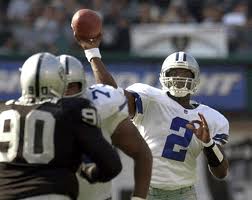
Troy Aikman’s 306-yard passing effort against the Bengals in Week 12 of the 2000 season is remembered by many as his last complete game victory in his 12-year career.  Not only did it take the Cowboys a long time to find a capable replacement to Aikman, but it took an astounding 31 games for another Dallas quarterback to top the 300-yard passing plateau.                              

Monday, September 2, 2013

The Dallas Cowboys,Jerry Jones & Labor Day

By Ben Bush Jr


As Dallas Cowboys fan, we can rest assured that coach, oops! I meant General Manager and Owner Jerry Jones, is busy this Labor Day.

While we relax with friends and family, Jerry is somewhere tirelessly promoting the only NFL team that really matters.

His quest for a Super Bowl apart from the lingering shadow of Jimmy Johnson continues. Bless his heart! :) 

Sunday, August 4, 2013

Jerry Jones, Bill Parcells & Quincy Carter - Dallas Cowboys Super Bowl Futility

 
Head Coach Bill Parcells and Quarterback Quincy Carter

Out of the many personalities within the pages of Decade of Futility, none were given a more thoughtful portrayal than Quincy Carter. In many areas concerning Carter’s up and down tenure as Dallas Cowboys quarterback, the truth was plain to see. And in those areas where a silent gray cloud thickly hovered, I at least had a hunch of what the truth was.

Unlike many of the hecklers and critics who have voiced their opinion over the past decade, I never thought of Quincy Carter as a draft-day failure, or even a quarterbacking bum. To me, Carter seemed to be a player with a certain potential that was impossible to realize simply because the coaching staff and management weren’t willing to be patient with him during his first two seasons.


Where much of the gray is concerning Carter happens to be within the time-frame that Bill Parcells was in Dallas. After leading Dallas to a 10-6 record, and a playoff berth, in 2003, Carter was abruptly released during the early stages of training camp the following August. 


The reason for his release has been debated ever since. Was it because he had failed a drug test? Was it because the Cowboys learned of an alleged addiction to marijuana? Or was it simply because the Cowboys were finally fed up with his inconsistent play?


The NFL Players Association (NFLPA) filed a grievance on behalf of Carter stating that he was unjustly released. In writing Decade of Futility I chose to stay clear of this lawsuit primarily because of its inherent controversy, but also because I thought the Cowboys actually had a good argument when they claimed that they waived Carter due to under-par performance. (To bring the NFLPA’s case into the book would, I thought, be an unwarranted distraction.)


Even during a career-best playoff campaign in 2003 there was always this air of gun-shyness about Carter, some imperceptible force that prompted him to retreat back into his shell at the imminent moment of progression. After being left for dead by previous offensive coordinators Jack Reilly and Bruce Coslet, Carter was given a second chance with Parcells and quarterbacks coach Sean Payton.


Needless to say, he didn’t take advantage. Though, I didn’t believe that it was for the reasons that many would like to believe. I always thought Carter, athletically speaking, was good enough to be a starting quarterback in the NFL, but something inside of him simply held him back. Even when he did have a solid support system around him.


Almost nine years to the day that he released Carter, Parcells finally gave his personal insight on Carter’s undoing this past week.


"I became pretty close with Quincy personally, and this kid had a lot of good qualities," Parcells said. "He was smart. He understood it. But I just couldn’t save his [butt]. I really couldn’t. 


"You just didn’t have the time. There he is, he got his team in the playoffs, he’s the starting quarterback of the Dallas Cowboys, he’s playing good, he’s improving, he can get out of trouble, he’s pretty smart, he can make almost every throw -- and it’s just, some people just can’t fight the pressure to succeed. 

"They just can’t fight it. It’s too much on them once the bar gets up a little bit. It’s too much. I don’t know all the problems or the demons exactly, but that’s what eventually took him down........


“"There were a couple of guys there that I knew I was going to have trouble counting on. [Drew] Henson because of his newness and he didn’t seem to be able to sort things out, and Quincy because of, you know ... "

Read about Quincy Carter’s final stand with the Dallas Cowboys in Chapter 11 of Decade of Futility.

For a hard-copy of Decade of Futility, click here:
https://www.createspace.com/4161551

For the Kindle version of Decade of Futility, click here: http://www.amazon.com/Decade-of-Futility-ebook/dp/B00DXFGLSE/ref=sr_1_1_title_0_main?s=books&ie=UTF8&qid=1373808496&sr=1-1&keywords=decade+of+futility

Monday, July 22, 2013

Clint Stoerner and Dallas Cowboys' Decade of Futility


Clint Stoerner had a lot going for him in the fall of 2001. A rookie free-agent pickup only a year before, this Texas native had been handed the keys to the Dallas offense after Quincy Carter and Anthony Wright went down with injuries, and then accomplished the unthinkable by leading the 1-4 Cowboys to a double-digit win over division rival Arizona.
A week later he even had the Cowboys a 17-point halftime lead on the road against the Giants.
So why didn't Stoerner wind up as the replacement to Troy Aikman?
Find out in Chapter 5 of Decade of Futility.


For a hard-copy of Decade of Futility, click here:
https://www.createspace.com/4161551

For the Kindle version of Decade of Futility, click here: http://www.amazon.com/Decade-of-Futility-ebook/dp/B00DXFGLSE/ref=sr_1_1_title_0_main?s=books&ie=UTF8&qid=1373808496&sr=1-1&keywords=decade+of+futility

Sunday, July 21, 2013

There are Reasons for Dallas Cowboys' Decade of Futility - Anthony Wright is One


Anthony Wright, shown here in a game against Oakland, started six games for the Cowboys after Troy Aikman's career-ending injury in December of 2000. Wright never topped the 200-yard mark in passing, a big reason he left the Cowboys with a 1-5 mark as a starter. His 9-yard performance against the Titans to end the 2000 season will forever be remembered as one of the most uninspiring outings in the history of America's Team.

For a hard-copy of Decade of Futility, click here:

For the Kindle version of Decade of Futility, click here:


Saturday, July 20, 2013

Decade of Futility Answers Questions For Dallas Cowboys Fans


"How could the Team of The '90s follow such a thrilling decade up with one of such infamy?" 

One of the most oft-asked questions in the sporting realm is answered by Ryan Bush in Decade of Futility with a history of the 21st Century Cowboys that goes beyond the cloud of defeat to unearth the many milestones that have resulted in a franchise that has gone from legendary to laughingstock.

For a hard-copy of Decade of Futility, click here:
https://www.createspace.com/4161551

For the Kindle version of Decade of Futility, click here: http://www.amazon.com/Decade-of-Futility-ebook/dp/B00DXFGLSE/ref=sr_1_1_title_0_main?s=books&ie=UTF8&qid=1373808496&sr=1-1&keywords=decade+of+futility

Friday, July 19, 2013

Jerry Jones Talks Super Bowl - An Annual Dallas Cowboys' Tradition


In Thursday's "State of The Cowboys" address, Jerry Jones showed several signs that three consecutive seasons without a playoff berth were taking its toll, admitting that the Cowboys "have got a lot of work to do."
 

Yet, being the cheerleader that he is, he couldn't help but talk about how much better the team is at this juncture than a year ago, and even managed to insert a comment - though tongue-in-cheek it may have seemed - about making a run at the Super Bowl.

This pre-training camp talk about a push to the Super Bowl is a Jones trademark. During the writing of Decade of Futility, I was shocked to learn just how much so. Since the "One Year Away" Cowboys shocked the world in 1992 by destroying Buffalo in Super Bowl XXVII by a 52-17 score, Jones has neglected to thrill listeners with Super aspirations a grand total of four times. That's four out of a possible twenty-one opportunities. Truly incredible.


Even more incredible are the circumstances surrounding those times when he deemed it better to be humble, rather than bold. The first occurrence was in the wake of Troy Aikman's retirement in 2001, when all the Cowboys were leaning upon was the unproven right arm of Georgia rookie Quincy Carter. Yes, Jones was magnanimous that day in his respect for the dark hour that his Cowboys found themselves in, foregoing any Super Bowl predictions, prophesying instead for a ho-hum mediocre campaign filled with only - yes, only - ten wins.


The only other times that Jones was silent on any personal visions of impending glory just happened to be during the first three years of Big Bill Parcells' four-year reign of pigskin terror, when Jones was effectively kept under wraps.


Jones talks so boldly because he wants the fans to know that he cares, and that he - in his position as the team's General Manager - has pieced together a roster that everyone will be proud of. He envisions himself as the sharpshooter in a darkened gym that calls his own shot on one three-pointer after another.


More importantly, is the fact that Jones believes these predictions are within the bounds of reason, even when others around him are pleading with him for patience, and temperance. 


The passing years have revealed that Jones is oblivious to any personal prohibitions related to drinking that most seductive of drinks, Cowboy Kool-Aid. The Cowboys have reaped the rewards this millennium of changing head coaches a mind-boggling four times. Five losing seasons, countless melodramas, one measly playoff victory, and a decade (2000-2009) that houses the lowest winning percentage in franchise history. 


And there, impervious to reality, criticism, and countless glaring statistics, stood the Cowboys owner yesterday, handing out a beverage that has enslaved the innocent and gullible for more than a decade. Yes, drinks are always on the house at Valley Ranch, no matter the hour, the venue, or circumstance.

Read more about Jerry Jones and the Worst Decade in Dallas Cowboys History in my new book Decade of Futility.

For a hard-copy of Decade of Futility, click here:
https://www.createspace.com/4161551


For the Kindle version of Decade of Futility, click here: http://www.amazon.com/Decade-of-Futility-ebook/dp/B00DXFGLSE/ref=sr_1_1_title_0_main?s=books&ie=UTF8&qid=1373808496&sr=1-1&keywords=decade+of+futility

Wednesday, July 17, 2013

Will Tony Romo Save the Cowboys From Their Decade of Futility?

2004 Pre-Season game against Raiders
 That Tony Romo has had his share of difficulties in win-or-go-home games has been well documented, but nobody can rightly question the fact that he is a championship-caliber quarterback. Romo is the reason that Jerry Jones and a whole host of expectant Cowboy fans can hold out hope that America's Team can get back to the top of football's steep, and winding, staircase. Yes, Romo often drives coaches crazy with ill-advised impulse decisions, but has also used this same gunslinger mentality to give his team many more victories that otherwise would have been improbable, if not impossible.
What, you ask, is his most important last-minute effort over his ten-year career? Well, only a meaningless preseason contest from the Black Hole in Oakland where Romo's go-for-broke mentality not only won a game, but might very well have saved a franchise with it.


Read the full story in Chapter 13 of Decade of Futility by Ryan Bush.

For a hard-copy of Decade of Futility, click here:

For the Kindle version of Decade of Futility, click 

Thursday, January 31, 2013

The Best Friend Quincy Carter Ever Had


Driving the bus for Bill Parcells

Life had been difficult for Quincy Carter after being released by the Dallas Cowboys in August of 2004.  He signed with the New York Jets later that fall, and started three games before missing a playoff game due to personal reasons.
Trouble with the Jets, too.
 As it turns out, Carter had been re-admitted to a drug-treatment center, a place, so it was discovered, Carter had been shortly before his release from the Cowboys.

Out of the NFL, Carter landed a gig with the Montreal Alouettes of the Canadian Football League in April 2006, but was released a month later.

That December he had found his way back to Irving, though he could have done without the publicity that involved it.  To put it bluntly, Carter was in jail, suspected of carrying under two ounces of marijuana, a class B misdemeanor.  Bail had been set at $500.  But nobody posted.

Not, that is, until Fort Worth Star-Telegram columnist Randy Galloway heard about it later that afternoon and decided to give Carter a break.  So he called Cowboy Bail Bonds in Garland and gave them his credit card number, setting the troubled Carter free.
Randy Galloway
“It’s Christmas, and I’ve certainly been very harsh with Quincy on the radio over the years because of what has happened to him off the field,” Galloway said.  “That was a Christmas gift.”

A gift that surprised Galloway, who never envisioned Carter staying in jail for a full 12 hours.  “I wondered where all his friends with the Cowboys were,” Galloway said.

In response to Galloway’s query, those “friends” of Carter’s were too engulfed by Romomania and the newly-unveiled plans for an Arlington mosque now known as JerryWorld to take time out for a former quarterback down on his luck.

Truly, there’s no place like home.


These stories and others can be found at Dallas Cowboys' Decade of Futility by Ryan Bush. They contain interesting information that didn't quite make it into Ryan's soon to be published book Decade of Futility - How the Leadership of Jerry Jones Transformed America's team into a 21st Century Debacle and resulted in the Worst Decade in Dallas Cowboys History. Visit the site now and provide your e-mail address to receive immediate notification when the book is published on Amazon.

Sunday, January 27, 2013

Jerry Jones’ Flashback: Not Throwback, But Throw It Back - Randy Galloway


 Jerry Jones’ public profile was looking unusually golden after giving Bill Parcells complete control of Valley Ranch.  But when Jones got behind a microphone a few short months later, his old self reappeared.
Randy Galloway
From the February 14 2003 edition of The Fort Worth Star-Telegram

By Randy Galloway


The Jerry Jones reclamation project – he’s done an amazing job lately of restoring his own shattered-into-tiny-pieces NFL image – hit one minor glitch this week.

Forget the Lebron James throwback jersey controversy that became a national debate.
Around here, many e-mailers became extremely concerned about a throwback Jerry.

This Jones quote from Monday’s sports section caused a bit of panic in the streets:  “As we are sitting here right now, I’m expecting Quincy to be back.  I don’t know that a veteran quarterback can beat Quincy out.”

That’s definitely something the old Jerry would have said.

When it comes, however, to the current quarterback situation, that’s obviously something for Big Bill to decide.  And Big Bill alone.

Actually, anything involving football personnel is now Big Bill’s domain based on public perception, Big Bill’s reputation, the franchise’s dismal track record for nearly a decade, and, of course, common sense.

Poll all local precincts, and the vote will be overwhelming for Big Bill being large and in charge.  But for most of his six weeks on the job, Parcells has remained in his Valley Ranch bunker, attempting to figure out exactly what to do with this mess.


To read the remainder of this article, please visit Talk of the Town at Dallas Cowboys' Decade of Futility by Ryan Bush.

Jerry Jones’ Devious Nature Surfaces Again - Randy Galloway


That Jerry Jones had lost patience with Dave Campo as a head coach was obvious to all, as the Cowboys headed down the stretch of the 2002 season destined for a third consecutive 5-11 season.  That Jones’ courting of Bill Parcells was also well known was accentuated by Jones’ stubborn belief that it was not.  Here is another classic example of Jones’ poor attempts at subterfuge in the face of a coaching change.
Randy Galloway
 From the Sunday December 29, 2002  edition of The Fort Worth Star-Telegram
By Randy Galloway

If you were reading the sports page Friday, then you saw it.  Saw an instant winner in the category of “Biggest Lie of the Week.”

By the way, our liar’s contest is restricted to the jock kingdom.  I cannot be held responsible for monitoring the comments of political windbags or corporate CEOs.
But a “source” passed along this heartwarming information for Friday morning publication:  “Out of respect for Dave Campo, there had been no contact all week between Jerry Jones and Bill Parcells.”......................................................................................


To read the remainder of this article, please go to Talk of the Town at Dallas Cowboys' Decade of Futility by Ryan Bush.

Saturday, January 19, 2013

Benching Bledsoe Far From Knee-Jerk Reaction for Bill Parcells

Drew Bledsoe

Drew Bledsoe was 12-10 as the starting quarterback for the Dallas Cowboys.  His twenty-second and final start in a Dallas uniform concluded with him on the bench and Tony Romo under center.  That the time had come for a quarterbacking change was obvious to everyone.  Bledsoe was the captain of a train-wreck stuck on the vanilla tracks of mediocrity.  Through 5 ½ games, Bledsoe had seven touchdown passes, eight interceptions and was sacked 16 times.  The Cowboys, 3-3 at that point of the 2006 season, were going nowhere with him at the controls.

The reason head coach Bill Parcells made the switch to Romo when he did is one of those little unsolved mysteries that taunts an unintelligent public in the face. Some say Parcells’ decision was the result of a halftime fit-to-be-tied rant that was more of an emotional resolution than anything else.  The illiterate like to think that Parcells was simply fed-up with his old New England cabin boy.  Yeah, well who wasn’t?
But why at halftime?  Why then? “Based on everything we thought we knew about Parcells, it made no sense for him to yank Bledsoe, go with Romo to start the third quarter, and then stay with Romo for the rest of the season,” observed Fort Worth Star-Telegram columnist Randy Galloway in his column later that same week.

So what was it in Bledsoe’s performance that told Parcells it was time to make a change?  The circumstances surrounding Bledsoe’s final pass is certainly conducive to answering that question.
The Cowboys looked to be in business when Demarcus Ware forced a Tiki Barber fumble that was recovered by linebacker Bradie James at the New York 14-yard line.  This came just moments after Bledsoe dove across the goal-line to cut the Giants’ lead to 12-7.  Now, the Cowboys were poised to enter halftime on top.

But Bledsoe, like he had done too often before, threw it all away.  Dallas had reached the four-yard line, and lined-up three receivers (Terrell Owens, Jason Witten & Anthony Fasano) to the offense’s right side, while Terry Glenn was lone opposite them.  The play was designed to go to one of the three options to the right.
Bledsoe took the snap from center, and dropped back with plenty of time.  The offensive line had done their job, for once.
Bledsoe overwhelmed
 But, apparently, a little extra time in the pocket unnerved Bledsoe, for he never saw a wide-open Fasano in the front of the end zone, and didn’t even think to look for Witten coming open outside of him.  Owens?  He was double-covered from the start.
With only one option remaining, Bledsoe quickly turned to his left and fired a bullet to the front-corner pylon…right into the arms of Giants cornerback Sam Madison, ending the scoring chance, and ending his career.
The situation, the area on the field, and the poor decision-making shown by Bledsoe on this play are reminiscent of several others he made during his brief stay in Dallas.
Bledsoe, Romo & Parcells
It was the fourth game of the 2005 season in Oakland that Bledsoe ignored a wide-open Jason Witten in the back of the end zone during the final minute, opting instead for the well-covered Terry Glenn at the goal-line.  The fourth-down pass fell incomplete, and the Raiders walked away 19-13 winners.  Three weeks later, an errant sideline pass in the game’s waning seconds found its way into the arms of a Seattle defensive back, setting up the game-winning field goal for the Seahawks in a game that the Cowboys had no business losing.
And only two weeks before Bledsoe’s final gaffe against the Giants, the Cowboys trailed Philadelphia by seven, when he tossed a last-minute interception by forcing a pass into double coverage in the end-zone.  Witten was the target this time, but Eagles cornerback Lito Sheppard snatched the ball out of the air and returned it 102 yards for a score.  Dallas fell to 2-2 with that 38-24 defeat.
The Cowboys hired Bledsoe to, at the very least, manage a game.  Too often, they found themselves watching as No. 11 threw games away.  In one form or fashion.
So for Parcells, it was really a no-brainer.  Was it better to risk a possible meltdown with Tony Romo at quarterback, or a certain conflagration down the road somewhere with Bledsoe at the helm?  The unknown factor around him said that Romo could win some games for the Cowboys where Bledsoe was definitely losing them.  

Bledsoe landed on the bench next to Parcells
Any gambler knows where to place his bet with those odds.

Thursday, January 17, 2013

Jerry Jones’ Worst Decision That Never Happened


The Cowboys were on the lookout for a new quarterback in the spring of 2001, having just released the legendary Troy Aikman.  It was unfamiliar territory for a Jerry Jones regime that had walked into Valley Ranch for the first time in 1989 virtually holding to the golden right hand of Aikman.

Now twelve years later, it was time to seek a replacement.  Without a first-round selection to look forward to in the draft, the free-agent wire was the operative avenue to find one.  Trent Dilfer, Elvis Grbac, and Tony Banks were the cream of the available crop.  Or so went the reports.  The Cowboys, so the story goes, had their eye on someone else.  Just who that someone was, is of definite interest.
Ryan Leaf

“In the spring, we did an evaluation of Ryan [Leaf],” Jerry Jones said in September of 2001.  “At that time, we thought he could help our team and have potential for the future.  That hasn’t changed.  He was our top choice in the spring for a veteran to come in, even before we made the Tony Banks decision.” An injury to his throwing wrist prevented the Cowboys from signing Leaf at the time, leading to the acquisition of Banks, an association that didn’t see the end of August.

There are so many ways that history could tell an even harsher tale of that season for the Cowboys had Leaf been healthy that spring.