On the front cover of Decade of Futility, there for everyone to behold, are pictures of Tony Romo and Jerry Jones. So who's the first person that often comes to mind when people see the book for the first time? None other than Tom Landry himself.
Here we are 24 years removed from it, and millions of people still haven't forgiven Jerry Jones for the way he fired Tom Landry. Without a doubt, the Saturday Night Massacre is just as vivid now as it was then.
The response I've gotten from the public makes me glad that, in telling the story of Jerry, I started from the very outset. Jerry Jones isn't the same without a Tom Landry to fire. He's a power figure that can only be understood when standing in the shadow of a man that he couldn't make room for, a man whose longstanding consistency, both on and off the field, remains alive in the hearts and minds of Cowboy fans even today.
Though he was rudely pushed aside on that evening of infamy, and though he has since passed from this world, it's almost as if Landry is still with us. Maybe a former player actually had it right when he said, "Tom Landry will always be a Dallas Cowboy."
Revisit the ins-and-outs and hows-and-whys of the worst stretch of yearly misfortune that America's Team has ever endured, all under the leadership of Jerry Jones. From the infamous Dave Campo years, to Bill Parcells four-year term in Big D', all the way to present day and the many obstructions that Jason Garrett is faced with, Decade Of Futility offers compelling insight and stories about why the Dallas Cowboys have failed to succeed in the 21st century.
Showing posts with label Dallas Cowboys' Decade of Futility.. Show all posts
Friday, September 13, 2013
Tuesday, September 3, 2013
The Dallas Cowboys' Past - Troy Aikman's Last Win
by Ryan Bush
![]() |
| Hall of Famer Troy Aikman |
Troy Aikman’s 306-yard passing effort against the Bengals in
Week 12 of the 2000 season is remembered by many as his last complete game
victory in his 12-year career. Not only
did it take the Cowboys a long time to find a capable replacement to Aikman, but
it took an astounding 31 games for another Dallas quarterback to top the
300-yard passing plateau.
Monday, September 2, 2013
The Dallas Cowboys,Jerry Jones & Labor Day
By Ben Bush Jr
As Dallas Cowboys fan, we can rest assured that coach, oops! I meant General Manager and Owner Jerry Jones, is busy this Labor Day.
While we relax with friends and family, Jerry is somewhere tirelessly promoting the only NFL team that really matters.
His quest for a Super Bowl apart from the lingering shadow of Jimmy Johnson continues. Bless his heart! :)
Tuesday, August 20, 2013
Dallas Cowboys Decade of Futility Launches: Interview on ESPN Radio
by Ben Bush Jr
This past Monday the 19th, publicity began with two Radio interviews of Ryan Bush about his newly published book, Decade of Futility. One was on 1660 AM ESPN Central Texas with Paul Catalina and Butch Henry. It was a lively 10 minute interview and drew a surprising number of questions for the short duration. Please listen to the interview.
Sunday, August 4, 2013
Jerry Jones, Bill Parcells & Quincy Carter - Dallas Cowboys Super Bowl Futility
![]() |
| Head Coach Bill Parcells and Quarterback Quincy Carter |
Out of the many personalities within the pages of Decade of Futility, none were given a more thoughtful portrayal than Quincy Carter. In many areas concerning Carter’s up and down tenure as Dallas Cowboys quarterback, the truth was plain to see. And in those areas where a silent gray cloud thickly hovered, I at least had a hunch of what the truth was.
Unlike many of the hecklers and critics who have voiced their opinion over the past decade, I never thought of Quincy Carter as a draft-day failure, or even a quarterbacking bum. To me, Carter seemed to be a player with a certain potential that was impossible to realize simply because the coaching staff and management weren’t willing to be patient with him during his first two seasons.
Where much of the gray is concerning Carter happens to be within the time-frame that Bill Parcells was in Dallas. After leading Dallas to a 10-6 record, and a playoff berth, in 2003, Carter was abruptly released during the early stages of training camp the following August.
The reason for his release has been debated ever since. Was it because he had failed a drug test? Was it because the Cowboys learned of an alleged addiction to marijuana? Or was it simply because the Cowboys were finally fed up with his inconsistent play?
The NFL Players Association (NFLPA) filed a grievance on behalf of Carter stating that he was unjustly released. In writing Decade of Futility I chose to stay clear of this lawsuit primarily because of its inherent controversy, but also because I thought the Cowboys actually had a good argument when they claimed that they waived Carter due to under-par performance. (To bring the NFLPA’s case into the book would, I thought, be an unwarranted distraction.)
Even during a career-best playoff campaign in 2003 there was always this air of gun-shyness about Carter, some imperceptible force that prompted him to retreat back into his shell at the imminent moment of progression. After being left for dead by previous offensive coordinators Jack Reilly and Bruce Coslet, Carter was given a second chance with Parcells and quarterbacks coach Sean Payton.
Needless to say, he didn’t take advantage. Though, I didn’t believe that it was for the reasons that many would like to believe. I always thought Carter, athletically speaking, was good enough to be a starting quarterback in the NFL, but something inside of him simply held him back. Even when he did have a solid support system around him.
Almost nine years to the day that he released Carter, Parcells finally gave his personal insight on Carter’s undoing this past week.
"I became pretty close with Quincy personally, and this kid had a lot of good qualities," Parcells said. "He was smart. He understood it. But I just couldn’t save his [butt]. I really couldn’t.
"You just didn’t have the time. There he is, he got his team in the playoffs, he’s the starting quarterback of the Dallas Cowboys, he’s playing good, he’s improving, he can get out of trouble, he’s pretty smart, he can make almost every throw -- and it’s just, some people just can’t fight the pressure to succeed.
"They just can’t fight it. It’s too much on them once the bar gets up a little bit. It’s too much. I don’t know all the problems or the demons exactly, but that’s what eventually took him down........
“"There were a couple of guys there that I knew I was going to have trouble counting on. [Drew] Henson because of his newness and he didn’t seem to be able to sort things out, and Quincy because of, you know ... "
Read about Quincy Carter’s final stand with the Dallas Cowboys in Chapter 11 of Decade of Futility.
For a hard-copy of Decade of Futility, click here:
https://www.createspace.com/4161551
For the Kindle version of Decade of Futility, click here: http://www.amazon.com/Decade-of-Futility-ebook/dp/B00DXFGLSE/ref=sr_1_1_title_0_main?s=books&ie=UTF8&qid=1373808496&sr=1-1&keywords=decade+of+futility
Labels:
America's Team,
Bill Parcells,
Book,
Dallas Cowboys,
Dallas Cowboys' Decade of Futility.,
Head Coach,
Jerry Jones,
NFL,
NFL Football,
Quarterback,
Quincy Carter,
Ryan Bush,
Super Bowl,
Your Heroes
Monday, July 22, 2013
Clint Stoerner and Dallas Cowboys' Decade of Futility
Clint Stoerner had a lot going for him in the fall of 2001. A rookie free-agent pickup only a year before, this Texas native had been handed the keys to the Dallas offense after Quincy Carter and Anthony Wright went down with injuries, and then accomplished the unthinkable by leading the 1-4 Cowboys to a double-digit win over division rival Arizona.
A week later he even had the Cowboys a 17-point halftime lead on the road against the Giants.
So why didn't Stoerner wind up as the replacement to Troy Aikman?
Find out in Chapter 5 of Decade of Futility.
For a hard-copy of Decade of Futility, click here:
https://www.createspace.com/4161551
For the Kindle version of Decade of Futility, click here: http://www.amazon.com/Decade-of-Futility-ebook/dp/B00DXFGLSE/ref=sr_1_1_title_0_main?s=books&ie=UTF8&qid=1373808496&sr=1-1&keywords=decade+of+futility
Labels:
America's Team,
Book,
Clint Stoerner,
Dallas Cowboys,
Dallas Cowboys' Decade of Futility.,
Dave Campo,
Jerry Jones,
New York Giants,
NFL,
NFL Football,
Quarterback,
Ryan Bush,
Super Bowl,
Your Heroes
Sunday, July 21, 2013
There are Reasons for Dallas Cowboys' Decade of Futility - Anthony Wright is One
Anthony Wright, shown here in a game against Oakland, started six games for the Cowboys after Troy Aikman's career-ending injury in December of 2000. Wright never topped the 200-yard mark in passing, a big reason he left the Cowboys with a 1-5 mark as a starter. His 9-yard performance against the Titans to end the 2000 season will forever be remembered as one of the most uninspiring outings in the history of America's Team.
For a hard-copy of Decade of Futility, click here:
For the Kindle version of Decade of Futility, click here:
Labels:
America's Team,
Anthony Wright,
Bill Parcells,
Book,
Dallas Cowboys,
Dallas Cowboys' Decade of Futility.,
Dave Campo,
Jerry Jones,
NFL,
NFL Football,
Owner,
Quarterback,
Ryan Bush,
Super Bowl,
Your Heroes
Saturday, July 20, 2013
Decade of Futility Answers Questions For Dallas Cowboys Fans
"How could the Team of The '90s follow such a thrilling decade up with one of such infamy?"
One of the most oft-asked questions in the sporting realm is answered by Ryan Bush in Decade of Futility with a history of the 21st Century Cowboys that goes beyond the cloud of defeat to unearth the many milestones that have resulted in a franchise that has gone from legendary to laughingstock.
For a hard-copy of Decade of Futility, click here:
https://www.createspace.com/4161551
For the Kindle version of Decade of Futility, click here: http://www.amazon.com/Decade-of-Futility-ebook/dp/B00DXFGLSE/ref=sr_1_1_title_0_main?s=books&ie=UTF8&qid=1373808496&sr=1-1&keywords=decade+of+futility
Friday, July 19, 2013
Jerry Jones Talks Super Bowl - An Annual Dallas Cowboys' Tradition
In Thursday's "State of The Cowboys" address, Jerry Jones showed several signs that three consecutive seasons without a playoff berth were taking its toll, admitting that the Cowboys "have got a lot of work to do."
Yet, being the cheerleader that he is, he couldn't help but talk about how much better the team is at this juncture than a year ago, and even managed to insert a comment - though tongue-in-cheek it may have seemed - about making a run at the Super Bowl.
This pre-training camp talk about a push to the Super Bowl is a Jones trademark. During the writing of Decade of Futility, I was shocked to learn just how much so. Since the "One Year Away" Cowboys shocked the world in 1992 by destroying Buffalo in Super Bowl XXVII by a 52-17 score, Jones has neglected to thrill listeners with Super aspirations a grand total of four times. That's four out of a possible twenty-one opportunities. Truly incredible.
Even more incredible are the circumstances surrounding those times when he deemed it better to be humble, rather than bold. The first occurrence was in the wake of Troy Aikman's retirement in 2001, when all the Cowboys were leaning upon was the unproven right arm of Georgia rookie Quincy Carter. Yes, Jones was magnanimous that day in his respect for the dark hour that his Cowboys found themselves in, foregoing any Super Bowl predictions, prophesying instead for a ho-hum mediocre campaign filled with only - yes, only - ten wins.
The only other times that Jones was silent on any personal visions of impending glory just happened to be during the first three years of Big Bill Parcells' four-year reign of pigskin terror, when Jones was effectively kept under wraps.
Jones talks so boldly because he wants the fans to know that he cares, and that he - in his position as the team's General Manager - has pieced together a roster that everyone will be proud of. He envisions himself as the sharpshooter in a darkened gym that calls his own shot on one three-pointer after another.
More importantly, is the fact that Jones believes these predictions are within the bounds of reason, even when others around him are pleading with him for patience, and temperance.
The passing years have revealed that Jones is oblivious to any personal prohibitions related to drinking that most seductive of drinks, Cowboy Kool-Aid. The Cowboys have reaped the rewards this millennium of changing head coaches a mind-boggling four times. Five losing seasons, countless melodramas, one measly playoff victory, and a decade (2000-2009) that houses the lowest winning percentage in franchise history.
And there, impervious to reality, criticism, and countless glaring statistics, stood the Cowboys owner yesterday, handing out a beverage that has enslaved the innocent and gullible for more than a decade. Yes, drinks are always on the house at Valley Ranch, no matter the hour, the venue, or circumstance.
Read more about Jerry Jones and the Worst Decade in Dallas Cowboys History in my new book Decade of Futility.
For a hard-copy of Decade of Futility, click here:
https://www.createspace.com/4161551
For the Kindle version of Decade of Futility, click here: http://www.amazon.com/Decade-of-Futility-ebook/dp/B00DXFGLSE/ref=sr_1_1_title_0_main?s=books&ie=UTF8&qid=1373808496&sr=1-1&keywords=decade+of+futility
Thursday, July 18, 2013
Jerry Jones & Bill Parcells - Just a Part of the Dallas Cowboys' Decade of Futility
![]() |
| Not exactly a match made in Heaven! |
“He’s a straightforward, honest guy,” Parcells said. “He really is. That’s all I look for. He was very supportive of me as a coach. Now were there things going on that occasionally I didn’t like? Yeah, there were, but that didn’t inhibit me from going to him, talking things out. He’s really great about that.”
So what drove these two apart? Find out in Chapters 15 and 16 of Decade of Futility.
For a hard-copy of Decade of Futility, click here:
https://www.createspace.com/
For the Kindle version of Decade of Futility, click here: http://www.amazon.com/
Wednesday, July 17, 2013
Will Tony Romo Save the Cowboys From Their Decade of Futility?
![]() |
| 2004 Pre-Season game against Raiders |
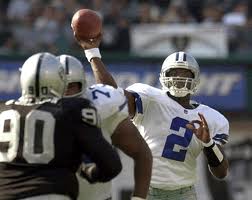
What, you ask, is his most important last-minute effort over his ten-year career? Well, only a meaningless preseason contest from the Black Hole in Oakland where Romo's go-for-broke mentality not only won a game, but might very well have saved a franchise with it.
Read the full story in Chapter 13 of Decade of Futility by Ryan Bush.
For a hard-copy of Decade of Futility, click here:
For the Kindle version of Decade of Futility, click
Tuesday, February 5, 2013
O.J. Santiago Trade Just Another Swing-and-Miss Moment At Tight End For Dallas Cowboys & Jerry Jones
| O. J. Santiago |
Tight ends had become a difficult position to get a handle on for the Dallas Cowboys in the wake of Jay Novacek’s retirement some three seasons before. They became even more so when backup tight end Mike Lucky suffered a season-ending injury during the early portion of training camp 2000.
Lucky’s misfortune left management scrambling to fit two
able bodies behind starter David LaFleur on the depth chart. And after more than three weeks of searching
and five tryouts, the Cowboys had managed to wrangle veteran Jackie Harris onto
the team, but still needed more. That’s
when the Falcons phoned and shipped fourth-year player O.J. Santiago their way,
allegedly solving all of the Cowboys’ problems.
Granted, it cost Dallas
fourth and seventh round draft picks, but that was chump change for shoring up
what had long been a weakness for the Dallas
offense. And remember, giving away draft
selections had become somewhat of a fad around Valley Ranch in those days, the
Cowboys only months removed from swapping two No. 1 choices with Seattle for speedy
receiver Joey Galloway.
The Cowboys considered Santiago a dual threat on offense
from the tight end position with a proficiency in both run-blocking – he helped
Jamal Anderson lead the NFC in rushing two years before – and pass receiving,
having hauled in a total of 42 passes over the previous two seasons. New head coach Dave Campo envisioned pairing Santiago with LaFleur on
early downs, and with Harris on passing downs, providing the Cowboys with a
rare flexibility to threaten the middle of the field at any time. “I feel very
comfortable he’ll be able to walk in and contribute immediately,” Campo said.
So it happened that a full week before the season was
scheduled to begin, Santiago boarded a flight to
Dallas, holding
tight to a Cowboys playbook. Rumor has
it that his plane never landed.
Though active for the first eleven games, Santiago
was released prior to Dallas’ Thanksgiving Day
game versus Minnesota,
having placed nary a scratch on a stat sheet.
Sunday, February 3, 2013
27-0 Embarrassment Versus Super Bowl-bound Ravens Left Jerry Jones Little Room To Dodge Reality
| There's not much to say! |
Throughout the twenty-first century, a bitter war between
reality and perception has been waged within the confines of Valley Ranch. Though perception persists, reality has
nevertheless prevailed, even sometimes in alarming fashion.
So in honor of today’s Super Bowl XLVII participant from the
AFC, let’s take a peek back into history and remind everybody just how good the
Baltimore Ravens were back in the year 2000…and how low the Dallas Cowboys of
once mighty glory had descended.
The Ravens were a Super Bowl-bound team reliant on a
powerful rushing attack led by rookie running back Jamal Lewis and a tenacious,
hard-hitting defense. The Cowboys, on
the other hand, were a bad 4-6 squad that owner Jerry Jones envisioned on the
way back up, a week removed from a gut-wrenching overtime defeat in
Philadelphia with backup quarterback Randall Cunningham filling in for Troy
Aikman. Now, with Aikman slotted to be
back in the starting lineup, Jones thought nothing could stop the Cowboys from
muscling past an unproven Ravens squad in an unfamiliar environment in Maryland.
What transpired, however, on a cold Sunday afternoon before
a Fox television audience was an omen of eventual triumph for the Ravens in
Super Bowl XXXV against New York
a few weeks later, and a harsh reminder that the Team of the ‘90s was nothing
more than a tread mark on the highway of irrelevance.
Going left, right and anywhere he pleased, Lewis rushed for
187 yards on only 28 totes. Of Lewis’
carries, 17 went for 7 yards or more, and seven rushing attempts totaled 10
yards or more. Coupled with a Dallas offensive attack
that never got off the team bus, it all added up to a 27-0 hope-shattering
defeat that left Jones little place to hide.
“This is very embarrassing,” said Jones following the
game. “This is stunning.
“Overtime losses have you looking at turnovers, at mistakes.
This is a clearer read on where we are.
The way Baltimore
ran the ball on us almost at will this left no doubt today.”
The head coach tried to be diplomatic in defeat, but even he
was rendered speechless. ““They came out
and blocked us,” Dave Campo said.
“Why? We’ll have to look at the
film and find out why.”
The “why” in it all can, in retrospect, be linked to the
ultimate destiny of each respective franchise.
Brian Billick, Art Modell and Ray Lewis stood tall
celebrating a championship season for the ages in early February, while Jones
and Co. licked their wounds at Valley Ranch trying to figure out how such a
5-11 squad could have fooled them into thinking that a Super Bowl was imminent.
Here we are twelve years later with Baltimore still playing
and Dallas back at home, the victim of sabotaged expectations yet again. One will be making another attempt at
football immortality, while the other continues to grapple with a reality that
fails to line up with in-house perception.
Some things never change.
The Day Jerry Jones Tossed Troy Aikman Aside
In Search For Head Coach, Jones’ Politics Reveals Just
Whose Image Is No. 1 At Valley Ranch
| Terry Donahue |
Public criticism had dogged his and his Cowboys’ steps every
inch of the way through a turbulent season that concluded in the smoke of a
6-10 train wreck. A very self-aware
Jerry Jones had just witnessed the official end to the Cowboys dynasty of the
1990’s as Dallas wobbled, teetered, and then finally crashed down the stretch
of the 1997 campaign, missing out on the playoffs for the first time in seven
years.
Now, Jones was out to do more than just replace the departed
Barry Switzer as head coach. He was out
to protect the two sacred foundational pieces that make up the bottom-line in
Big D’; his trophy case and, yes, himself.
He desperately wanted to hire a head coach who called his
own plays, if only to quell the crazy rumor going around that a meddlesome
Jones spent the previous season in the suite of offensive coordinator Ernie
Zampese suggesting plays. Publicly, the
status-quo linked the necessity for an offensive mind with the health of
battered quarterback Troy Aikman.
That much was well known.
What was not known, however, was just how sensitive the owner’s public
image had become.
After a few weeks of what was repeatedly referred to as an
“intensive coaching search,” it appeared that Aikman’s old ball coach at UCLA,
Terry Donahue, was all locked up for the job.
Uh, in fact he was. A news
conference announcing the hiring of the fourth head coach in franchise history
had been scheduled.
But then Donahue read the small print on the contract.
The Cowboys had included a clause in Donahue’s contract,
clearly stating that he would be fined $25,000 every time he said anything that
might throw a poor light on the Cowboys, or in particular, Jerry Jones.
Donahue balked at it and walked away.
“We never thought the insubordination clause, and certainly
the money ($500,000 annually), would be the thing that turned it one way or the
other,” Jones said. “He was offered the
job…I did feel he’d come in as a coordinator on an entry-level basis [pay
scale] into the NFL as opposed to coming in as a Super Bowl coach.”
But then Jones tried to smooth things over and suggest that
Donahue wasn’t really the right man for the job, ignoring the fact that he was
merely hours away from announcing the news to the entire world. “…We were not
on the same page of how we were going to do things on offense,” Jones
said. “I was on the page whether he
could do it or not, but when the issues on the contract came up, I talked with
my son Stephen and we realized we were trying to put a larger foot in a small
shoe here. We’re trying to make
something happen, and we’re not a team that needs years to make something
happen.”
Donahue wasn’t willing to tow the company line every week
during the season, especially on a team such as Dallas coming off a 6-10 season and with many
bumps still in front of them.
Jones finally found his man in Chan Gailey, who reportedly
signed the contract with the same clause in it that Donahue had issues with.
| Chan Gailey |
And this doesn’t mean that Gailey, an up and coming
assistant, was desperate for a head coaching job. Calling out his players or
owner publicly simply wasn’t in Gailey’s nature. Agreeing to those terms didn’t bother him in
the least.
| No Protection |
But rather than protecting Aikman’s backside, the hiring of
Gailey proved to only shelter Jones. The
Cowboys now not only had a head coach doubling as an offensive coordinator, but
a man able and ready to wield feather duster and furniture polish in honor of
the Owner to each and every press conference.
| All is Well! |
So, with Jones having alighted upon the perfect solution to
safeguard his own domicile, the fact that his good buddy Aikman was to be
saddled with an offensive scheme that he couldn’t appreciate had suddenly lost
any significance.
Labels:
America's Team,
Book,
Chan Gailey,
Dallas Cowboys,
Dallas Cowboys' Decade of Futility.,
Head Coach,
Jerry Jones,
NFL,
Quarterback,
Ryan Bush,
Super Bowl,
Terry Donahue,
Troy Aikman,
UCLA
Thursday, January 31, 2013
The Best Friend Quincy Carter Ever Had
| Driving the bus for Bill Parcells |
Life had been difficult for Quincy Carter after being
released by the Dallas Cowboys in August of 2004. He signed with the New York Jets later that
fall, and started three games before missing a playoff game due to personal
reasons.
| Trouble with the Jets, too. |
As it turns out, Carter had been re-admitted to a
drug-treatment center, a place, so it was discovered, Carter had been shortly
before his release from the Cowboys.
Out of the NFL, Carter landed a gig with the Montreal
Alouettes of the Canadian Football League in April 2006, but was released a
month later.
That December he had found his way back to Irving, though he could have done without the
publicity that involved it. To put it bluntly,
Carter was in jail, suspected of carrying under two ounces of marijuana, a
class B misdemeanor. Bail had been set
at $500. But nobody posted.
Not, that is, until Fort Worth Star-Telegram columnist Randy
Galloway heard about it later that afternoon and decided to give Carter a
break. So he called Cowboy Bail Bonds in
Garland and
gave them his credit card number, setting the troubled Carter free.
| Randy Galloway |
“It’s Christmas, and I’ve certainly been very harsh with Quincy on the radio over the years because of what has
happened to him off the field,” Galloway
said. “That was a Christmas gift.”
A gift that surprised Galloway, who never envisioned Carter
staying in jail for a full 12 hours. “I
wondered where all his friends with the Cowboys were,” Galloway
said.
In response to Galloway’s query, those “friends” of Carter’s
were too engulfed by Romomania and the newly-unveiled plans for an Arlington
mosque now known as JerryWorld to take time out for a former quarterback down
on his luck.
Truly, there’s no place like home.
These stories and others can be found at Dallas Cowboys' Decade of Futility by Ryan Bush. They contain interesting information that didn't quite make it into Ryan's soon to be published book Decade of Futility - How the Leadership of Jerry Jones Transformed America's team into a 21st Century Debacle and resulted in the Worst Decade in Dallas Cowboys History. Visit the site now and provide your e-mail address to receive immediate notification when the book is published on Amazon.
Wednesday, January 30, 2013
Jerry Jones Isn’t Only Lacking As A GM - Tim Cowlishaw
Less than two weeks after the Cowboys finished the 2000 season with
their worst record in ten years, Tim Cowlishaw examines one of the biggest lies
ever to bounce off the walls of Valley Ranch.
Yes, the future indeed appeared bleak not only because Jones was the
general manager, but because he also wielded ultimate authority as the owner.
Hit the accelerator at the first sighting of all doughnut shops. Watch something on television that does not include calls for clipping, charging or icing.
The list is short one essential item. Before we advance too deeply into the odyssey of 2001, one more resolution must be added, and it’s one we can share.
Could we please have a moratorium on the following phrase, still uttered by too many voices in too many places?
Jerry Jones is a great owner, but an awful general manager.
Isn’t it obvious, with only the smallest exertion of thought, that the truth of the latter precludes the former?
Isn’t the first order of business for any owner to hire the best general manager available?
And yet this man who once assured that 500 coaches could win Super Bowl with the Cowboys’ talent contends that only one qualifies as general manager.
And it’s the one who has run the ship aground.............................................................................
To view the remainder of this article, go to Talk Of the Town. There you will find the beginning of a compilation of past articles by Dallas Ft-Worth area Sportswriters about the Dallas Cowboys during the first decade of the 21st Century. Also visit the remainder of the site in preparation for the soon publication of Ryan Bush's book Decade of Futility - How the Leadership of Jerry Jones transformed America's Team into a 21st Century Debacle and resulted in the Worst Decade in Dallas Cowboys History.
From the January 5 2001 edition of The Dallas Morning News
By Tim Cowlishaw
Hit the accelerator at the first sighting of all doughnut shops. Watch something on television that does not include calls for clipping, charging or icing.
The list is short one essential item. Before we advance too deeply into the odyssey of 2001, one more resolution must be added, and it’s one we can share.
Could we please have a moratorium on the following phrase, still uttered by too many voices in too many places?
Jerry Jones is a great owner, but an awful general manager.
Isn’t it obvious, with only the smallest exertion of thought, that the truth of the latter precludes the former?
Isn’t the first order of business for any owner to hire the best general manager available?
And yet this man who once assured that 500 coaches could win Super Bowl with the Cowboys’ talent contends that only one qualifies as general manager.
And it’s the one who has run the ship aground.............................................................................
To view the remainder of this article, go to Talk Of the Town. There you will find the beginning of a compilation of past articles by Dallas Ft-Worth area Sportswriters about the Dallas Cowboys during the first decade of the 21st Century. Also visit the remainder of the site in preparation for the soon publication of Ryan Bush's book Decade of Futility - How the Leadership of Jerry Jones transformed America's Team into a 21st Century Debacle and resulted in the Worst Decade in Dallas Cowboys History.
Cowboys' Terrell Owens’ Life Never A Concern In Philly
| Happy Times for Owens! |
The earth shook when Dallas Cowboys wide receiver Terrell Owens was hospitalized in September 2006 for what police referred to as “attempting suicide by prescription pain medication.”
But, while the show of support and sympathy from Jon Gruden, Chad Johnson, and others was going full steam ahead in the media’s grapevine, a malevolent voice from Owens’ old stomping grounds in Philadelphia sounded loud and clear.
No, the Eagles were never worried about the condition of Owens, even at the darkest hour.
Why?
“We always thought he was crazy, never mental,” a source with the Eagles said. “…That’s not even remotely him. This guy loves himself too much.”
Leave it to the City of Brotherly Love to coin their best wishes in such loving terms.
Click Here for more Glimpses Into The Past.
Sunday, January 27, 2013
Jerry Jones’ Flashback: Not Throwback, But Throw It Back - Randy Galloway
Jerry Jones’ public profile was looking unusually golden after giving
Bill Parcells complete control of Valley Ranch.
But when Jones got behind a microphone a few short months later, his old
self reappeared.
| Randy Galloway |
From the February 14 2003 edition
of The Fort Worth Star-Telegram
By Randy Galloway
The Jerry Jones reclamation project – he’s done an amazing
job lately of restoring his own shattered-into-tiny-pieces NFL image – hit one
minor glitch this week.
Forget the Lebron James throwback jersey controversy that
became a national debate.
Around here, many e-mailers became extremely concerned about
a throwback Jerry.
This Jones quote from Monday’s sports section caused a bit
of panic in the streets: “As we are
sitting here right now, I’m expecting Quincy
to be back. I don’t know that a veteran
quarterback can beat Quincy
out.”
That’s definitely something the old Jerry would have said.
When it comes, however, to the current quarterback
situation, that’s obviously something for Big Bill to decide. And Big Bill alone.
Actually, anything involving football personnel is now Big
Bill’s domain based on public perception, Big Bill’s reputation, the
franchise’s dismal track record for nearly a decade, and, of course, common
sense.
Poll all local precincts, and the vote will be overwhelming
for Big Bill being large and in charge.
But for most of his six weeks on the job, Parcells has remained in his
Valley Ranch bunker, attempting to figure out exactly what to do with this
mess.
To read the remainder of this article, please visit Talk of the Town at Dallas Cowboys' Decade of Futility by Ryan Bush.
Subscribe to:
Posts (Atom)