Showing posts with label Dave Campo. Show all posts

Monday, April 14, 2014

Management, Talent Evaluation Key Suspects in Dallas Cowboys' Dismissal of QB Anthony Wright


In writing the book "Decade of Futility," I spent an entire chapter dealing strictly with Jerry Jones' quarterback carousel of 2001, paying close attention to the Quincy Carter and Clint Stoerner sagas.  What has gone unnoticed therein is that I ultimately edited out an additional story to this heavily stacked segment.  To include it would only show how poor the management and talent evaluation was for the Cowboys in those days, which had already been heavily inferred by the chapter anyway.  So in order not to get bogged down and be redundant, I left it out.
But that doesn't mean it isn't compelling, nor of consequence.  Because it is.
The story centers around reserve quarterback Anthony Wright and a knee injury suffered during Dallas' Week 5 victory over Washington on Monday Night Football.  The game, typical of the times, was a snoozer, the Cowboys nipping the Redskins 9-7 on a last-second field goal by Tim Seder.
And while ABC was bemoaning lackluster ratings and heavy criticism of color commentator Dennis Miller, Jerry Jones was riding a rare emotional high after seeing his team grab their first win of the season, telling reporters afterwards, “I got a little of that Super Bowl feeling again.”
Jones’ mood suffered a severe drop-off over the next 24 hours as team doctors broke the news: Wright’s knee was damaged to the point that, while he technically could still suit up and play on Sundays, it would be far safer if Wright were to immediately undergo surgery to repair it.
There was no secret about the fact that the Cowboys wanted Wright to put off surgery and continue standing in for the injured Quincy Carter, until Carter was healthy enough to re-take the field in early December.
Wright, on the other hand, wanted to protect his career’s longevity, and never thought twice about his decision to go under the knife, thus ending his season.
As a consequence, the Cowboys soured on Wright, cutting ties altogether with the four-year pro the following August.  Their reasoning was simple enough: coaches and certain team officials didn’t think Wright cared enough about football, which, ironically enough, was the exact same reason they opted to cut Tony Banks before him.
But did Jerry Jones really need a banged-up Anthony Wright as his quarterback?  Should he really have been Jones’ preference at that juncture?
Ultimately, the organization put their foot down with Wright; either suck it up, or else….
The timing for such hard-ball management is particularly odd.  Wright was no star in the making.  He had entered the 2001 season as the No. 3 quarterback and, after roughly 14 quarters of action over the season’s first five weeks, Wright had done his “backup” label justice.
He could throw for three touchdowns the first half, and three interceptions in the second.  He could throw for 180 yards one week, and only 80 the next.
He was a better passer than Carter, but relied heavily upon his legs to get him out of trouble when the pocket collapsed, which it was wont to do quite often that season.
And now, with a bum knee and severely limited mobility, it is a wonder the Cowboys could envision that version of Wright being as, or more, effective than Clint Stoerner.  Wright’s ability to scramble, one could argue, was the only thing that offensive coordinator Jack Reilly had learned to trust.  Trailing Oakland 28-21 during their Week 4 contest and facing a fourth-and-1 with less than two minutes remaining, Reilly didn’t call for an off-tackle run by Emmitt Smith, or even a quick slant pattern to Joey Galloway.  He, instead, opted for a quarterback draw with Wright.
The result (Wright was stopped short of the line to gain) is of no consequence when compared to the philosophy.  The offense really had only one thing working for them when Wright was under center: his mobility.
But with that vanished in the wreckage of an unfortunate injury against Washington, what were the Cowboys expecting to place their faith in for the next game?


You can read more about the Dallas Cowboys' crazy 2001 season in Ryan Bush's new book about The Worst Decade in Dallas Cowboys history "Decade of Futility."  Use the following link to order your copy today:https://www.createspace.com/4161551


Tuesday, April 8, 2014

Jamar Martin An NFL Draft Story of What Might Have Been For Dallas Cowboys


Like quarterbacks, the position of fullback has been one which the Cowboys have seldom taken notice of on draft day during this century. Seeing rookie fullback Chris Gronkowski miss a block that led to Tony Romo's season-ending injury in 2010 might help explain why. Seemingly, fullbacks are no longer needed in Dallas, or the NFL for that matter.
But, was there actually one whom Dallas drafted that was actually worth having? Seeing as how it was Jerry Jones who made the selection, it would likely surprise the reader to discover the answer lies in the affirmative.
The year was 2002, a season in which many budding positives would ultimately be rendered negative by a season-long quarterback tussle that split the Dallas locker room down the middle. Yes, Jerry was to blame in large part for that mess, but not with this single unfortunate event.
It was no secret that the Cowboys had been in need of a fullback since Daryl "Moose" Johnston retired following the 1999 campaign. Robert Thomas had been sub-par as a lead-blocker for two seasons, and his overtime fumble against Philadelphia in 2000 still didn't sit well with coaches. So Jones and head coach Dave Campo tried to remedy the solution by selecting Ohio State wrecking ball Jamar Martin in the fourth round of April's draft.
When Martin took to the field in training camp, it was apparent that he was one rookie worth keeping an eye on. A punishing blocker in the hole, Martin was piling up one pancake block after another. Well on his way to earning a roster spot, Martin found his career suddenly in jeopardy when he tore his ACL, and was placed on the team's injured reserve list.
And though he joined the Cowboys for training camp the following August, Martin was not the same explosive player as before, and found himself unemployed shortly thereafter.
 
 
Use the following link to purchase your copy of Ryan Bush's new book about the Worst Decade in Dallas Cowboys history "Decade of Futility"......https://www.createspace.com/4161551


Monday, April 7, 2014

Drafting QB Position Has Been All Swing, All Miss For Jerry Jones & Dallas Cowboys


Quarterback is a position that the Dallas Cowboys have rarely wasted time drafting during the Jerry Jones era. But when they have, it's been nothing short of headline-grabbing, though this might have something to do with Jones' penchant for outrageous remarks.
Jones made a sudden audible during the 2001 draft to select Georgia signal-caller Quincy Carter in the second round, dubbing Carter "the next Troy Aikman." Less than a year later, Jones went out and found Carter's replacement in dual-star passer Chad Hutchinson. Neither of Carter or Hutchinson was on the Dallas roster when the Cowboys began the 2004 season.
In 2009, Jones made another draft day reach, taking Texas A&M freelancer Stephen McGee with the first selection in the fourth round. McGee, according to Jones, possessed qualities equal to that of Tony Romo, and was thought by many within the organization to be a capable successor to Romo.
Though McGee did win his only NFL start, a 14-13 affair in Week 17 of the 2010 season, he was released during the spring of 2012 after failing to progress in Jason Garrett's offense.
The Cowboys currently have three quarterbacks on their roster, so it isn't likely that Jerry will audible this year. But make no mistake, if he does, people will surely take notice.


Use the following link to purchase your copy of Ryan Bush's new book about The Worst Decade in Dallas Cowboys history "Decade of Futility"....https://www.createspace.com/4161551


Monday, December 2, 2013

Decade of Futility - December Here Again to Haunt Snake-Bitten Cowboys


And so here the Cowboys are again, facing their bitterest rival of the 21st Century: December.
Since 2000, the Cowboys are 23-32 during the final month of the calendar year, and have only two winning marks to their credit.
In which seasons did the Cowboys post a winning record in December, and who were the quarterbacks?

Tuesday, November 26, 2013

Decade of Futility - 2002 Cowboys Bunch Imploded After Thanksgiving Day Win Over Redskins


Rookie quarterback Chad Hutchinson won his second consecutive start on Thanksgiving Day 2002 in a 27-20 conquering of the Redskins, leading to talk of a playoff push for the 5-7 Cowboys.
Ten days later, Hutchinson tried to make it three in a row against the streaking 49ers at Texas Stadium, but was relegated to bystander status as the team around him imploded in the fourth quarter. That early-December loss spelled a disgraceful end to a Dave Campo regime built on hot-air and surreal expectations. Read about it in Chapter 8 of Decade of Futility.


Friday, November 22, 2013

Expectations For Dallas Cowboys WR Reggie Swinton Misfounded


Reporters simply relay what they have been told, and that’s all that Chip Brown was doing when, during the 2001 preseason, he wrote of Cowboys wideout Reggie Swinton, “The 6-foot Swinton fits the big-receiver profile the Cowboys are looking for.”
In no way is this an indictment of the former Dallas Morning News staff writer. Rather it shows the delusion that the Cowboys' front-office was living under, depicting Swinton as a “big” receiver that could complement the sideline skills of Joey Galloway and Raghib Ismail by going across the middle for catches, ala Keyshawn Johnson.
Even while competing against the likes of Darrin Chiaverini, Wane McGarity and Damon Hodge, Swinton never managed to make it as a receiver with the Cowboys. Nor did he make it as one anywhere else.
His lanky frame and superior vision enabled him to enjoy a 7-year career as a return specialist with Dallas, Green Bay, Detroit and Arizona, but was little more than an afterthought within any offensive game plan.


Monday, October 14, 2013

Decade of Futility - Pros, Cons & Misfortunes of Dallas Cowboys' Trade for Joey Galloway Unlocked In New Book


Its details forgotten by the throngs, its merits argued by sports historians, the Dallas Cowboys' trade for wide receiver Joey Galloway in February of 2000 is still a point of contention for some even today. Was Galloway really worth two first round draft picks like Jerry Jones thought, or was the trade a complete wash?
By breaking the philosophy of the trade down into several increments, Decade of Futility lays this argument to rest once and for all with new, never-before-published material that accounts for every piece of the puzzle: words, actions, production, and misfortune. Crisp and refreshingly straight-forward, Chapter 4 of Decade of Futility simplifies the mysteriously complex Joey Galloway Trade.


For a hard-copy of Decade of Futility, click here:
https://www.createspace.com/4161551


For the Kindle version of Decade of Futility, click here: http://www.amazon.com/Decade-of-Futility-ebook/dp/B00DXFGLSE/ref=sr_1_1_title_0_main?s=books&ie=UTF8&qid=1373808496&sr=1-1&keywords=decade+of+futility

Tuesday, September 24, 2013

Decade of Futility - New Dallas Cowboys Book "Decade of Futility" Now Available Through Barnes & Noble

You can now purchase the new book "Decade of Futility: How The Leadership of Jerry Jones Transformed America's Team into a 21st Century Debacle, Resulting in The Worst Decade in Dallas Cowboys' History" online through Barnes & Noble.
Get your copy today!

Sunday, September 22, 2013

Decade of Futility - Chad Hutchinson Debacle Another Case of Poor Timing For Dallas Cowboys

Chad Hutchinson landed in the wrong place at the wrong time when he landed in Dallas. Having not been under center for four years, Hutchinson needed time to not only adapt to the speed of the pro game, but to the game of football in general.
He was afforded neither. Hutchinson was starting by the halfway point of his rookie season, and was expected to turn a 3-4 Cowboys club into a playoff beast.
Hutchinson's inexperience, coupled with a porous offensive line, contributed to a miserable second half of the 2002 season in which expectations collided head-on with reality...and destruction.  By the time the smoke cleared from their combustible 5-11 finish, the Cowboys had a brand-new coaching staff, and Hutchinson was looking for any semblance of a support system.
Hutchinson lost his starting job to Quincy Carter the following August in a QB duel that some suggest wasn't nearly as close as new head coach Bill Parcells suggested it was. He never started a game for the Cowboys again.
 Read more about Chad Hutchinson in Chapter 6 of Decade of Futility.


Tuesday, September 3, 2013

The Dallas Cowboys' Past - Troy Aikman's Last Win


by Ryan Bush


Hall of Famer Troy Aikman
Troy Aikman’s 306-yard passing effort against the Bengals in Week 12 of the 2000 season is remembered by many as his last complete game victory in his 12-year career.  Not only did it take the Cowboys a long time to find a capable replacement to Aikman, but it took an astounding 31 games for another Dallas quarterback to top the 300-yard passing plateau.                              

Monday, July 22, 2013

Clint Stoerner and Dallas Cowboys' Decade of Futility


Clint Stoerner had a lot going for him in the fall of 2001. A rookie free-agent pickup only a year before, this Texas native had been handed the keys to the Dallas offense after Quincy Carter and Anthony Wright went down with injuries, and then accomplished the unthinkable by leading the 1-4 Cowboys to a double-digit win over division rival Arizona.
A week later he even had the Cowboys a 17-point halftime lead on the road against the Giants.
So why didn't Stoerner wind up as the replacement to Troy Aikman?
Find out in Chapter 5 of Decade of Futility.


For a hard-copy of Decade of Futility, click here:
https://www.createspace.com/4161551

For the Kindle version of Decade of Futility, click here: http://www.amazon.com/Decade-of-Futility-ebook/dp/B00DXFGLSE/ref=sr_1_1_title_0_main?s=books&ie=UTF8&qid=1373808496&sr=1-1&keywords=decade+of+futility

Sunday, July 21, 2013

There are Reasons for Dallas Cowboys' Decade of Futility - Anthony Wright is One


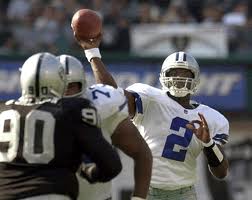
Anthony Wright, shown here in a game against Oakland, started six games for the Cowboys after Troy Aikman's career-ending injury in December of 2000. Wright never topped the 200-yard mark in passing, a big reason he left the Cowboys with a 1-5 mark as a starter. His 9-yard performance against the Titans to end the 2000 season will forever be remembered as one of the most uninspiring outings in the history of America's Team.

For a hard-copy of Decade of Futility, click here:

For the Kindle version of Decade of Futility, click here:


Tuesday, February 5, 2013

O.J. Santiago Trade Just Another Swing-and-Miss Moment At Tight End For Dallas Cowboys & Jerry Jones

O. J. Santiago

Tight ends had become a difficult position to get a handle on for the Dallas Cowboys in the wake of Jay Novacek’s retirement some three seasons before.  They became even more so when backup tight end Mike Lucky suffered a season-ending injury during the early portion of training camp 2000.

Lucky’s misfortune left management scrambling to fit two able bodies behind starter David LaFleur on the depth chart.  And after more than three weeks of searching and five tryouts, the Cowboys had managed to wrangle veteran Jackie Harris onto the team, but still needed more.  That’s when the Falcons phoned and shipped fourth-year player O.J. Santiago their way, allegedly solving all of the Cowboys’ problems.

Granted, it cost Dallas fourth and seventh round draft picks, but that was chump change for shoring up what had long been a weakness for the Dallas offense.  And remember, giving away draft selections had become somewhat of a fad around Valley Ranch in those days, the Cowboys only months removed from swapping two No. 1 choices with Seattle for speedy receiver Joey Galloway.

The Cowboys considered Santiago a dual threat on offense from the tight end position with a proficiency in both run-blocking – he helped Jamal Anderson lead the NFC in rushing two years before – and pass receiving, having hauled in a total of 42 passes over the previous two seasons.  New head coach Dave Campo envisioned pairing Santiago with LaFleur on early downs, and with Harris on passing downs, providing the Cowboys with a rare flexibility to threaten the middle of the field at any time. “I feel very comfortable he’ll be able to walk in and contribute immediately,” Campo said.

So it happened that a full week before the season was scheduled to begin, Santiago boarded a flight to Dallas, holding tight to a Cowboys playbook.  Rumor has it that his plane never landed.

Though active for the first eleven games, Santiago was released prior to Dallas’ Thanksgiving Day game versus Minnesota, having placed nary a scratch on a stat sheet.


Sunday, February 3, 2013

27-0 Embarrassment Versus Super Bowl-bound Ravens Left Jerry Jones Little Room To Dodge Reality


There's not much to say!

Throughout the twenty-first century, a bitter war between reality and perception has been waged within the confines of Valley Ranch.  Though perception persists, reality has nevertheless prevailed, even sometimes in alarming fashion.

So in honor of today’s Super Bowl XLVII participant from the AFC, let’s take a peek back into history and remind everybody just how good the Baltimore Ravens were back in the year 2000…and how low the Dallas Cowboys of once mighty glory had descended.

The Ravens were a Super Bowl-bound team reliant on a powerful rushing attack led by rookie running back Jamal Lewis and a tenacious, hard-hitting defense.  The Cowboys, on the other hand, were a bad 4-6 squad that owner Jerry Jones envisioned on the way back up, a week removed from a gut-wrenching overtime defeat in Philadelphia with backup quarterback Randall Cunningham filling in for Troy Aikman.  Now, with Aikman slotted to be back in the starting lineup, Jones thought nothing could stop the Cowboys from muscling past an unproven Ravens squad in an unfamiliar environment in Maryland.

What transpired, however, on a cold Sunday afternoon before a Fox television audience was an omen of eventual triumph for the Ravens in Super Bowl XXXV against New York a few weeks later, and a harsh reminder that the Team of the ‘90s was nothing more than a tread mark on the highway of irrelevance.

Going left, right and anywhere he pleased, Lewis rushed for 187 yards on only 28 totes.  Of Lewis’ carries, 17 went for 7 yards or more, and seven rushing attempts totaled 10 yards or more.  Coupled with a Dallas offensive attack that never got off the team bus, it all added up to a 27-0 hope-shattering defeat that left Jones little place to hide.

“This is very embarrassing,” said Jones following the game.  “This is stunning.
“Overtime losses have you looking at turnovers, at mistakes. This is a clearer read on where we are.  The way Baltimore ran the ball on us almost at will this left no doubt today.”

The head coach tried to be diplomatic in defeat, but even he was rendered speechless.  ““They came out and blocked us,” Dave Campo said.  “Why?  We’ll have to look at the film and find out why.”

The “why” in it all can, in retrospect, be linked to the ultimate destiny of each respective franchise. 

Brian Billick, Art Modell and Ray Lewis stood tall celebrating a championship season for the ages in early February, while Jones and Co. licked their wounds at Valley Ranch trying to figure out how such a 5-11 squad could have fooled them into thinking that a Super Bowl was imminent.

Here we are twelve years later with Baltimore still playing and Dallas back at home, the victim of sabotaged expectations yet again.  One will be making another attempt at football immortality, while the other continues to grapple with a reality that fails to line up with in-house perception.

Some things never change.

Sunday, January 27, 2013

Jerry Jones’ Devious Nature Surfaces Again - Randy Galloway


That Jerry Jones had lost patience with Dave Campo as a head coach was obvious to all, as the Cowboys headed down the stretch of the 2002 season destined for a third consecutive 5-11 season.  That Jones’ courting of Bill Parcells was also well known was accentuated by Jones’ stubborn belief that it was not.  Here is another classic example of Jones’ poor attempts at subterfuge in the face of a coaching change.
Randy Galloway
 From the Sunday December 29, 2002  edition of The Fort Worth Star-Telegram
By Randy Galloway

If you were reading the sports page Friday, then you saw it.  Saw an instant winner in the category of “Biggest Lie of the Week.”

By the way, our liar’s contest is restricted to the jock kingdom.  I cannot be held responsible for monitoring the comments of political windbags or corporate CEOs.
But a “source” passed along this heartwarming information for Friday morning publication:  “Out of respect for Dave Campo, there had been no contact all week between Jerry Jones and Bill Parcells.”......................................................................................


To read the remainder of this article, please go to Talk of the Town at Dallas Cowboys' Decade of Futility by Ryan Bush.