Showing posts with label Quarterback. Show all posts

Friday, May 9, 2014

Passing on Johnny Manziel Was a Positive Moment For Jerry Jones, But Doesn’t Mean Culture Has Changed in Dallas


The post-selection depression was staggering.  Almost more so than the actual selection.

After falling into the Cowboys’ laps like everyone had dreamed but dared hardly hope, Jerry Jones up and pulled the rug out from under everyone’s feet, selecting offensive guard Zack Martin out of Notre Dame instead of the beloved quarterback Johnny Manziel.  As you can imagine, record-high ratings hit the floor in an instant as parties were canceled and frivolity rendered mute.

But as clearer heads prevail and full consciousness returns, the world is left wondering at Martin.  Or, rather Jerry.

What came over team owner Jerry Jones to convince him to take an offensive lineman when it was so obviously unexpected? 

A safety?  Yes. 

Defensive end?  Yes. 

Johnny Football?  Millions of anxious fans sure hoped so.

But offensive lineman?  Really?

It has been the favorite topic of discussion on this good Friday to discern whether or not Jerry in fact is turning over a new leaf in his duties.  In hindsight, the selection of Martin did address the one weakness of a surprisingly stable Cowboy offensive line from a year ago: guard.  Martin was the highest-rated player left on Dallas’ draft board and is every bit of a quality pick.

Does that in fact make Mr. Jones a quality General Manager of a sudden?

Let’s hold off on that declaration, at least for a few more days.  25 years and counting of mishaps is not erased merely by one surprisingly good draft-day brain wave.  Jerry might just as easily turn around and select another quarterback today, and bring about the Manziel discussion all over again.

It can not be said for certain at this juncture what the owner’s thought process was last night.  Was he out to get simply the best player because of value, or was it stubborn faith that his shell-shocked defense, healthy at this moment, would transform themselves come September with many of the same faces from a year ago?

As erratic as the Cowboys’ drafts have been the past twenty years, these are important questions that will be answered over the next two days.  Not that positive developments will make Jerry a hero, but will at least give his audience something relevant to pat him on the back for.
 
 
You can read more about the Dallas Cowboys and their struggle with recent drafts in Ryan Bush's new book about Jerry Jones and The Worst Decade in Dallas Cowboys' History, "Decade of Futility." Use the following link to purchase your copy today:https://www.createspace.com/4161551


Thursday, May 8, 2014

Prospect of Landing Johnny Manziel Adds Intrigue For Dallas Cowboys, Pressure for Jerry Jones


We have asked.  Jerry has answered.

We have implored.  Jerry has declined.

We say maybe.  Jerry says never.

It’s been a good long while since there has been this much unity from Jerry’s bleachers over a prospect in the weeks leading up to the draft.  Too long.  But that’s what happens when you have only won one playoff game in nearly two decades.  Apathy becomes a local custom rather than a personal reaction.

The NFL draft hasn’t meant much to Cowboy Nation for many moons now because they have found little constructive activity in their team’s war room.  This year is different, though.  Because this year Johnny Football is calling it quits in College Station to join the big boys of the professional ranks, where money and legend can proliferate freely.

Johnny Football is a Texas gunslinger who would’ve made Slingin’ Sammy proud with his rocket arm, dare-devil attitude, and knack for the spotlight.  In two years at Texas A&M, all Johnny Manziel did was win a Heisman Trophy as a freshman, knock off mighty Alabama, and almost single-handedly put the Aggies in the national title conversation.

So accomplished is he that millions have taken hold of the thought that, “Maybe Johnny can fix the Cowboys.”

The Cowboys, as we all know by now, are in the deplorable habit of winning half of their games, losing the other half, and going home for the winter in a thoroughly confused state of emotions.

The franchise quarterback, 34-year old Tony Romo, is overpaid, likely overweight at this date, and some claim overwhelmingly overhyped.  His teammates all spend their off-season talking about the need to improve.  The owner, speaking for all, claims infinite satisfaction.

The football crazed town of Dallas knoweth no peace, for the team they are sworn to does not compute.  Nor compete.

The fans know this isn’t acceptable, so have offered their remedy, hoping that team owner Jerry Jones is thinking along those same lines.  As of yesterday, Jones claims he is not, citing an over-abundance at the quarterback position and a need to win now.

Remember, the topic of quarterbacks is a sensitive one around Valley Ranch right now, and with good reason.  The reality is that Jones has yet to find a quarterback in the draft during his 25 years on the job, and he doesn’t need any reminders on that front.

Jones has always claimed he learned a hard, but valuable, lesson when he watched Troy Aikman slide into retirement in 2001 due to complications from a bad back and a rash of concussions.  He blamed himself for not having a capable replacement waiting in the wings, ready to stand up when Aikman did finally go down, and considered himself at fault for going nearly six full seasons before another franchise quarterback happened along.  Jones says he’s aware more than ever how important the position is in today’s game.

Thursday is his chance to prove as much.

Right now there are only two quarterbacking carcasses behind Romo on the depth chart, moldy fossils of past failures who are simply hanging onto the league’s skirts for employment.  Brandon Weeden is a 31-year old with two years of experience in dog-eared Cleveland where he became, according to multiple reports, emotionally scarred for life.  Well, cheer up, Brandon.  You wouldn’t be the first.

Reserve signal-caller Caleb Hanie had a similar experience with Chicago.

The backup Jones wanted – Kyle Orton – hasn’t showed his face around the Ranch during the team’s optional workouts this spring, and word has it that Orton is currently leaning towards retirement.  That’s not the news that Jones should be fine with hearing, especially considering that his 34-year old starter is coming off his second back procedure in the space of a calendar year.

But Jones doesn’t appear concerned with this in the least and appears fully prepared to place his trust in his overwhelmed pair of reserves and Romo’s improving health.  Jones can’t be blamed for trying to stick with Romo.  He just needs to be aware of the danger of shoving all his chips that way.  Age at the quarterback position isn’t a problem until decay starts to set in.

And you can be certain that somebody at Valley Ranch has made him cognizant of what a financial boon it would be to select Manziel (yes, money is a big thing with Jerry).  According to the latest statistics, Jerry’s house of 100-dollar bills could use a serious upgrade, as poor production on Sundays has boosted inflation and caused the Cowboys to fall behind the competition.

Of the top selling individual players jerseys from the 2013 season, wide receiver Dez Bryant is the top Cowboy, checking in at No. 13.  Tight end Jason Witten was No. 17.  The quarterback of America’s Team could be found well down the list at No. 23.  Eleven quarterbacks ranked ahead of Romo, including public punching bags Ryan Tannehill and Eli Manning.

The Cowboys ranked fourth overall in team merchandise sales, behind Seattle, Denver, and San Francisco.

Selecting Manziel would be an instant boost in revenue, with jerseys and tickets flying off the shelf.  Yes, Jerry would likely sell out both of his preseason games this coming August, too.

A stable franchise could afford to take Manziel with the sixteenth selection.  Alas, that is not a state the Cowboys have enjoyed since Bill Parcells’ scowl was seen on the Dallas sideline.

A rebuilding franchise could do the same.

The Cowboys, unfortunately, fall somewhere in between at this juncture in time.  Without the luxury of either a winning or losing season to direct Jerry’s off-season agenda, the Cowboys have never lacked an identity more than in 2014.

The head coach preaches balance but stands helpless as Jerry’s system of quarterback-offensive coordinator autonomy enacts a pass-first circus that, more often than not, winds up in disaster.  The defense was non-existent a year ago, and certainly hasn’t improved on paper as of yet.

It would seem unfair to want to put Johnny Football in that kind of a situation, if it weren’t for the fact that Manziel dealt with a lot of those same problems at A&M.  Manziel threw the ball all over the yard in college, and had to outscore a gutless defense on most weekends, so probably isn’t going to be overwhelmed at being asked to score points in Dallas, too.

Jerry, on the other hand, is overwhelmed, and will probably be more so than ever by Thursday, according to past Cowboy drafts.  Maybe the prospect of having to choose Manziel will provide a rare moment of clarity from the Valley Ranch war room.

For over-expectant fans of the silver and blue, this one possibility is their one hope for the future.  And without it coming to fruition, the Monday morning commute will certainly be a drab experience when it dawns upon them that they will never have a Johnny, but will always have a Jerry.


You can read more about Jerry Jones' Draft-Day struggles in Ryan Bush's new book about The Worst Decade in Dallas Cowboys' History, "Decade of Futility."  Use the following link to purchase your copy today:https://www.createspace.com/

Monday, April 14, 2014

Management, Talent Evaluation Key Suspects in Dallas Cowboys' Dismissal of QB Anthony Wright


In writing the book "Decade of Futility," I spent an entire chapter dealing strictly with Jerry Jones' quarterback carousel of 2001, paying close attention to the Quincy Carter and Clint Stoerner sagas.  What has gone unnoticed therein is that I ultimately edited out an additional story to this heavily stacked segment.  To include it would only show how poor the management and talent evaluation was for the Cowboys in those days, which had already been heavily inferred by the chapter anyway.  So in order not to get bogged down and be redundant, I left it out.
But that doesn't mean it isn't compelling, nor of consequence.  Because it is.
The story centers around reserve quarterback Anthony Wright and a knee injury suffered during Dallas' Week 5 victory over Washington on Monday Night Football.  The game, typical of the times, was a snoozer, the Cowboys nipping the Redskins 9-7 on a last-second field goal by Tim Seder.
And while ABC was bemoaning lackluster ratings and heavy criticism of color commentator Dennis Miller, Jerry Jones was riding a rare emotional high after seeing his team grab their first win of the season, telling reporters afterwards, “I got a little of that Super Bowl feeling again.”
Jones’ mood suffered a severe drop-off over the next 24 hours as team doctors broke the news: Wright’s knee was damaged to the point that, while he technically could still suit up and play on Sundays, it would be far safer if Wright were to immediately undergo surgery to repair it.
There was no secret about the fact that the Cowboys wanted Wright to put off surgery and continue standing in for the injured Quincy Carter, until Carter was healthy enough to re-take the field in early December.
Wright, on the other hand, wanted to protect his career’s longevity, and never thought twice about his decision to go under the knife, thus ending his season.
As a consequence, the Cowboys soured on Wright, cutting ties altogether with the four-year pro the following August.  Their reasoning was simple enough: coaches and certain team officials didn’t think Wright cared enough about football, which, ironically enough, was the exact same reason they opted to cut Tony Banks before him.
But did Jerry Jones really need a banged-up Anthony Wright as his quarterback?  Should he really have been Jones’ preference at that juncture?
Ultimately, the organization put their foot down with Wright; either suck it up, or else….
The timing for such hard-ball management is particularly odd.  Wright was no star in the making.  He had entered the 2001 season as the No. 3 quarterback and, after roughly 14 quarters of action over the season’s first five weeks, Wright had done his “backup” label justice.
He could throw for three touchdowns the first half, and three interceptions in the second.  He could throw for 180 yards one week, and only 80 the next.
He was a better passer than Carter, but relied heavily upon his legs to get him out of trouble when the pocket collapsed, which it was wont to do quite often that season.
And now, with a bum knee and severely limited mobility, it is a wonder the Cowboys could envision that version of Wright being as, or more, effective than Clint Stoerner.  Wright’s ability to scramble, one could argue, was the only thing that offensive coordinator Jack Reilly had learned to trust.  Trailing Oakland 28-21 during their Week 4 contest and facing a fourth-and-1 with less than two minutes remaining, Reilly didn’t call for an off-tackle run by Emmitt Smith, or even a quick slant pattern to Joey Galloway.  He, instead, opted for a quarterback draw with Wright.
The result (Wright was stopped short of the line to gain) is of no consequence when compared to the philosophy.  The offense really had only one thing working for them when Wright was under center: his mobility.
But with that vanished in the wreckage of an unfortunate injury against Washington, what were the Cowboys expecting to place their faith in for the next game?


You can read more about the Dallas Cowboys' crazy 2001 season in Ryan Bush's new book about The Worst Decade in Dallas Cowboys history "Decade of Futility."  Use the following link to order your copy today:https://www.createspace.com/4161551


Sunday, April 13, 2014

For Jerry Jones, Parting Ways With Tony Banks Proved To Be Start of Trouble For 2001 Dallas Cowboys


Quarterbacks were in abundance on the Valley Ranch lawn during the 2001 campaign. The legendary Troy Aikman had retired in April, and team owner Jerry Jones was busy orchestrating a merry game of musical chairs in searching for a suitable ...replacement.
Cowboy enthusiasts remember the scene well, their beloved franchise owning five different starting signal callers from August to November, the once fabled "America's Team" looking strangely akin to a minor league baseball team searching desperately for a reliable arm out of the bullpen.
Tony Banks, Quincy Carter, Anthony Wright, Clint Stoerner, and Ryan Leaf each found their respective names at the top of the depth chart at some point during the season, a 5-11 marathon that seemed to accomplish more damage than good.
The unquestioned starter coming out of mini-camps, the sixth-year veteran Banks was inexplicably cut early in preseason by an owner who seemed determined to reach the 10-win threshold he had so outrageously predicted months before with the raw talent of Carter, a wide-eyed rookie from Georgia. While Jerry was busy touting excitement and a brighter future as the primary causes for such a bold move, fans and sportswriters could only shake their head in bewilderment. They didn't understand Jones using a second-round pick on Carter in the April draft, and they surely couldn't see why Banks should be ditched while his replacement had yet to even learn the proper grip of a professional size football.
Without a doubt, it was a decision that destroyed the season before it ever started, the Cowboys' once-aspiring offense destined for NFL ineptitude.


Read more about "The Quarterback Carousel" in Chapter 5 of Ryan Bush's new book about The Worst Decade in Dallas Cowboys history "Decade of Futility." Use the following link to purchase your copy today:https://www.createspace.com/4161551

Monday, April 7, 2014

Drafting QB Position Has Been All Swing, All Miss For Jerry Jones & Dallas Cowboys


Quarterback is a position that the Dallas Cowboys have rarely wasted time drafting during the Jerry Jones era. But when they have, it's been nothing short of headline-grabbing, though this might have something to do with Jones' penchant for outrageous remarks.
Jones made a sudden audible during the 2001 draft to select Georgia signal-caller Quincy Carter in the second round, dubbing Carter "the next Troy Aikman." Less than a year later, Jones went out and found Carter's replacement in dual-star passer Chad Hutchinson. Neither of Carter or Hutchinson was on the Dallas roster when the Cowboys began the 2004 season.
In 2009, Jones made another draft day reach, taking Texas A&M freelancer Stephen McGee with the first selection in the fourth round. McGee, according to Jones, possessed qualities equal to that of Tony Romo, and was thought by many within the organization to be a capable successor to Romo.
Though McGee did win his only NFL start, a 14-13 affair in Week 17 of the 2010 season, he was released during the spring of 2012 after failing to progress in Jason Garrett's offense.
The Cowboys currently have three quarterbacks on their roster, so it isn't likely that Jerry will audible this year. But make no mistake, if he does, people will surely take notice.


Use the following link to purchase your copy of Ryan Bush's new book about The Worst Decade in Dallas Cowboys history "Decade of Futility"....https://www.createspace.com/4161551


Monday, March 24, 2014

Randy Galloway's Description of A Jerry Jones-Johnny Manziel Hook-Up Nothing Short of Classic


Johnny Manziel and Jerry Jones in the same town? What a wild ride that would be. Here's Randy Galloway's take from earlier in the month:
"Jerry and Johnny? That, friends, is the perfect pig-and-slop combo. If you think it’s nuts around Va...lley Ranch now ... Jerry and Johnny out there loose on local streets would be a Twitter tsunami. Forget high school in Kerrville. Forget his Aggies days. Johnny was born to play for Jerry."

The scary part about that is Galloway is right. Johnny was born to play for Jerry.


Read about Jerry Jones and the Worst Decade in Dallas Cowboys history in Ryan Bush's new book "Decade of Futility."  Use the following link to order your copy today:https://www.createspace.com/4161551

Monday, December 2, 2013

Decade of Futility - December Here Again to Haunt Snake-Bitten Cowboys


And so here the Cowboys are again, facing their bitterest rival of the 21st Century: December.
Since 2000, the Cowboys are 23-32 during the final month of the calendar year, and have only two winning marks to their credit.
In which seasons did the Cowboys post a winning record in December, and who were the quarterbacks?

Tuesday, November 26, 2013

Decade of Futility - 2002 Cowboys Bunch Imploded After Thanksgiving Day Win Over Redskins


Rookie quarterback Chad Hutchinson won his second consecutive start on Thanksgiving Day 2002 in a 27-20 conquering of the Redskins, leading to talk of a playoff push for the 5-7 Cowboys.
Ten days later, Hutchinson tried to make it three in a row against the streaking 49ers at Texas Stadium, but was relegated to bystander status as the team around him imploded in the fourth quarter. That early-December loss spelled a disgraceful end to a Dave Campo regime built on hot-air and surreal expectations. Read about it in Chapter 8 of Decade of Futility.


Sunday, September 22, 2013

Decade of Futility - Chad Hutchinson Debacle Another Case of Poor Timing For Dallas Cowboys

Chad Hutchinson landed in the wrong place at the wrong time when he landed in Dallas. Having not been under center for four years, Hutchinson needed time to not only adapt to the speed of the pro game, but to the game of football in general.
He was afforded neither. Hutchinson was starting by the halfway point of his rookie season, and was expected to turn a 3-4 Cowboys club into a playoff beast.
Hutchinson's inexperience, coupled with a porous offensive line, contributed to a miserable second half of the 2002 season in which expectations collided head-on with reality...and destruction.  By the time the smoke cleared from their combustible 5-11 finish, the Cowboys had a brand-new coaching staff, and Hutchinson was looking for any semblance of a support system.
Hutchinson lost his starting job to Quincy Carter the following August in a QB duel that some suggest wasn't nearly as close as new head coach Bill Parcells suggested it was. He never started a game for the Cowboys again.
 Read more about Chad Hutchinson in Chapter 6 of Decade of Futility.


Sunday, August 4, 2013

Jerry Jones, Bill Parcells & Quincy Carter - Dallas Cowboys Super Bowl Futility

 
Head Coach Bill Parcells and Quarterback Quincy Carter

Out of the many personalities within the pages of Decade of Futility, none were given a more thoughtful portrayal than Quincy Carter. In many areas concerning Carter’s up and down tenure as Dallas Cowboys quarterback, the truth was plain to see. And in those areas where a silent gray cloud thickly hovered, I at least had a hunch of what the truth was.

Unlike many of the hecklers and critics who have voiced their opinion over the past decade, I never thought of Quincy Carter as a draft-day failure, or even a quarterbacking bum. To me, Carter seemed to be a player with a certain potential that was impossible to realize simply because the coaching staff and management weren’t willing to be patient with him during his first two seasons.


Where much of the gray is concerning Carter happens to be within the time-frame that Bill Parcells was in Dallas. After leading Dallas to a 10-6 record, and a playoff berth, in 2003, Carter was abruptly released during the early stages of training camp the following August. 


The reason for his release has been debated ever since. Was it because he had failed a drug test? Was it because the Cowboys learned of an alleged addiction to marijuana? Or was it simply because the Cowboys were finally fed up with his inconsistent play?


The NFL Players Association (NFLPA) filed a grievance on behalf of Carter stating that he was unjustly released. In writing Decade of Futility I chose to stay clear of this lawsuit primarily because of its inherent controversy, but also because I thought the Cowboys actually had a good argument when they claimed that they waived Carter due to under-par performance. (To bring the NFLPA’s case into the book would, I thought, be an unwarranted distraction.)


Even during a career-best playoff campaign in 2003 there was always this air of gun-shyness about Carter, some imperceptible force that prompted him to retreat back into his shell at the imminent moment of progression. After being left for dead by previous offensive coordinators Jack Reilly and Bruce Coslet, Carter was given a second chance with Parcells and quarterbacks coach Sean Payton.


Needless to say, he didn’t take advantage. Though, I didn’t believe that it was for the reasons that many would like to believe. I always thought Carter, athletically speaking, was good enough to be a starting quarterback in the NFL, but something inside of him simply held him back. Even when he did have a solid support system around him.


Almost nine years to the day that he released Carter, Parcells finally gave his personal insight on Carter’s undoing this past week.


"I became pretty close with Quincy personally, and this kid had a lot of good qualities," Parcells said. "He was smart. He understood it. But I just couldn’t save his [butt]. I really couldn’t. 


"You just didn’t have the time. There he is, he got his team in the playoffs, he’s the starting quarterback of the Dallas Cowboys, he’s playing good, he’s improving, he can get out of trouble, he’s pretty smart, he can make almost every throw -- and it’s just, some people just can’t fight the pressure to succeed. 

"They just can’t fight it. It’s too much on them once the bar gets up a little bit. It’s too much. I don’t know all the problems or the demons exactly, but that’s what eventually took him down........


“"There were a couple of guys there that I knew I was going to have trouble counting on. [Drew] Henson because of his newness and he didn’t seem to be able to sort things out, and Quincy because of, you know ... "

Read about Quincy Carter’s final stand with the Dallas Cowboys in Chapter 11 of Decade of Futility.

For a hard-copy of Decade of Futility, click here:
https://www.createspace.com/4161551

For the Kindle version of Decade of Futility, click here: http://www.amazon.com/Decade-of-Futility-ebook/dp/B00DXFGLSE/ref=sr_1_1_title_0_main?s=books&ie=UTF8&qid=1373808496&sr=1-1&keywords=decade+of+futility

Monday, July 22, 2013

Clint Stoerner and Dallas Cowboys' Decade of Futility


Clint Stoerner had a lot going for him in the fall of 2001. A rookie free-agent pickup only a year before, this Texas native had been handed the keys to the Dallas offense after Quincy Carter and Anthony Wright went down with injuries, and then accomplished the unthinkable by leading the 1-4 Cowboys to a double-digit win over division rival Arizona.
A week later he even had the Cowboys a 17-point halftime lead on the road against the Giants.
So why didn't Stoerner wind up as the replacement to Troy Aikman?
Find out in Chapter 5 of Decade of Futility.


For a hard-copy of Decade of Futility, click here:
https://www.createspace.com/4161551

For the Kindle version of Decade of Futility, click here: http://www.amazon.com/Decade-of-Futility-ebook/dp/B00DXFGLSE/ref=sr_1_1_title_0_main?s=books&ie=UTF8&qid=1373808496&sr=1-1&keywords=decade+of+futility

Sunday, July 21, 2013

There are Reasons for Dallas Cowboys' Decade of Futility - Anthony Wright is One


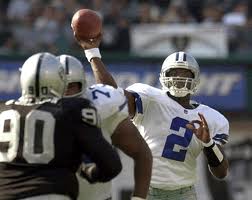
Anthony Wright, shown here in a game against Oakland, started six games for the Cowboys after Troy Aikman's career-ending injury in December of 2000. Wright never topped the 200-yard mark in passing, a big reason he left the Cowboys with a 1-5 mark as a starter. His 9-yard performance against the Titans to end the 2000 season will forever be remembered as one of the most uninspiring outings in the history of America's Team.

For a hard-copy of Decade of Futility, click here:

For the Kindle version of Decade of Futility, click here:


Sunday, February 3, 2013

27-0 Embarrassment Versus Super Bowl-bound Ravens Left Jerry Jones Little Room To Dodge Reality


There's not much to say!

Throughout the twenty-first century, a bitter war between reality and perception has been waged within the confines of Valley Ranch.  Though perception persists, reality has nevertheless prevailed, even sometimes in alarming fashion.

So in honor of today’s Super Bowl XLVII participant from the AFC, let’s take a peek back into history and remind everybody just how good the Baltimore Ravens were back in the year 2000…and how low the Dallas Cowboys of once mighty glory had descended.

The Ravens were a Super Bowl-bound team reliant on a powerful rushing attack led by rookie running back Jamal Lewis and a tenacious, hard-hitting defense.  The Cowboys, on the other hand, were a bad 4-6 squad that owner Jerry Jones envisioned on the way back up, a week removed from a gut-wrenching overtime defeat in Philadelphia with backup quarterback Randall Cunningham filling in for Troy Aikman.  Now, with Aikman slotted to be back in the starting lineup, Jones thought nothing could stop the Cowboys from muscling past an unproven Ravens squad in an unfamiliar environment in Maryland.

What transpired, however, on a cold Sunday afternoon before a Fox television audience was an omen of eventual triumph for the Ravens in Super Bowl XXXV against New York a few weeks later, and a harsh reminder that the Team of the ‘90s was nothing more than a tread mark on the highway of irrelevance.

Going left, right and anywhere he pleased, Lewis rushed for 187 yards on only 28 totes.  Of Lewis’ carries, 17 went for 7 yards or more, and seven rushing attempts totaled 10 yards or more.  Coupled with a Dallas offensive attack that never got off the team bus, it all added up to a 27-0 hope-shattering defeat that left Jones little place to hide.

“This is very embarrassing,” said Jones following the game.  “This is stunning.
“Overtime losses have you looking at turnovers, at mistakes. This is a clearer read on where we are.  The way Baltimore ran the ball on us almost at will this left no doubt today.”

The head coach tried to be diplomatic in defeat, but even he was rendered speechless.  ““They came out and blocked us,” Dave Campo said.  “Why?  We’ll have to look at the film and find out why.”

The “why” in it all can, in retrospect, be linked to the ultimate destiny of each respective franchise. 

Brian Billick, Art Modell and Ray Lewis stood tall celebrating a championship season for the ages in early February, while Jones and Co. licked their wounds at Valley Ranch trying to figure out how such a 5-11 squad could have fooled them into thinking that a Super Bowl was imminent.

Here we are twelve years later with Baltimore still playing and Dallas back at home, the victim of sabotaged expectations yet again.  One will be making another attempt at football immortality, while the other continues to grapple with a reality that fails to line up with in-house perception.

Some things never change.

The Day Jerry Jones Tossed Troy Aikman Aside


In Search For Head Coach, Jones’ Politics Reveals Just Whose Image Is No. 1 At Valley Ranch

Terry Donahue
Public criticism had dogged his and his Cowboys’ steps every inch of the way through a turbulent season that concluded in the smoke of a 6-10 train wreck.  A very self-aware Jerry Jones had just witnessed the official end to the Cowboys dynasty of the 1990’s as Dallas wobbled, teetered, and then finally crashed down the stretch of the 1997 campaign, missing out on the playoffs for the first time in seven years.

Now, Jones was out to do more than just replace the departed Barry Switzer as head coach.  He was out to protect the two sacred foundational pieces that make up the bottom-line in Big D’; his trophy case and, yes, himself. 

He desperately wanted to hire a head coach who called his own plays, if only to quell the crazy rumor going around that a meddlesome Jones spent the previous season in the suite of offensive coordinator Ernie Zampese suggesting plays.  Publicly, the status-quo linked the necessity for an offensive mind with the health of battered quarterback Troy Aikman.

That much was well known.  What was not known, however, was just how sensitive the owner’s public image had become.

After a few weeks of what was repeatedly referred to as an “intensive coaching search,” it appeared that Aikman’s old ball coach at UCLA, Terry Donahue, was all locked up for the job.  Uh, in fact he was.  A news conference announcing the hiring of the fourth head coach in franchise history had been scheduled.

But then Donahue read the small print on the contract.

The Cowboys had included a clause in Donahue’s contract, clearly stating that he would be fined $25,000 every time he said anything that might throw a poor light on the Cowboys, or in particular, Jerry Jones.

Donahue balked at it and walked away.

“We never thought the insubordination clause, and certainly the money ($500,000 annually), would be the thing that turned it one way or the other,” Jones said.  “He was offered the job…I did feel he’d come in as a coordinator on an entry-level basis [pay scale] into the NFL as opposed to coming in as a Super Bowl coach.”

But then Jones tried to smooth things over and suggest that Donahue wasn’t really the right man for the job, ignoring the fact that he was merely hours away from announcing the news to the entire world. “…We were not on the same page of how we were going to do things on offense,” Jones said.  “I was on the page whether he could do it or not, but when the issues on the contract came up, I talked with my son Stephen and we realized we were trying to put a larger foot in a small shoe here.  We’re trying to make something happen, and we’re not a team that needs years to make something happen.”

Donahue wasn’t willing to tow the company line every week during the season, especially on a team such as Dallas coming off a 6-10 season and with many bumps still in front of them.

Jones finally found his man in Chan Gailey, who reportedly signed the contract with the same clause in it that Donahue had issues with.
Chan Gailey
 And this doesn’t mean that Gailey, an up and coming assistant, was desperate for a head coaching job. Calling out his players or owner publicly simply wasn’t in Gailey’s nature.  Agreeing to those terms didn’t bother him in the least.
No Protection
 But rather than protecting Aikman’s backside, the hiring of Gailey proved to only shelter Jones.  The Cowboys now not only had a head coach doubling as an offensive coordinator, but a man able and ready to wield feather duster and furniture polish in honor of the Owner to each and every press conference.
All is Well!
 So, with Jones having alighted upon the perfect solution to safeguard his own domicile, the fact that his good buddy Aikman was to be saddled with an offensive scheme that he couldn’t appreciate had suddenly lost any significance.


Thursday, January 31, 2013

The Best Friend Quincy Carter Ever Had


Driving the bus for Bill Parcells

Life had been difficult for Quincy Carter after being released by the Dallas Cowboys in August of 2004.  He signed with the New York Jets later that fall, and started three games before missing a playoff game due to personal reasons.
Trouble with the Jets, too.
 As it turns out, Carter had been re-admitted to a drug-treatment center, a place, so it was discovered, Carter had been shortly before his release from the Cowboys.

Out of the NFL, Carter landed a gig with the Montreal Alouettes of the Canadian Football League in April 2006, but was released a month later.

That December he had found his way back to Irving, though he could have done without the publicity that involved it.  To put it bluntly, Carter was in jail, suspected of carrying under two ounces of marijuana, a class B misdemeanor.  Bail had been set at $500.  But nobody posted.

Not, that is, until Fort Worth Star-Telegram columnist Randy Galloway heard about it later that afternoon and decided to give Carter a break.  So he called Cowboy Bail Bonds in Garland and gave them his credit card number, setting the troubled Carter free.
Randy Galloway
“It’s Christmas, and I’ve certainly been very harsh with Quincy on the radio over the years because of what has happened to him off the field,” Galloway said.  “That was a Christmas gift.”

A gift that surprised Galloway, who never envisioned Carter staying in jail for a full 12 hours.  “I wondered where all his friends with the Cowboys were,” Galloway said.

In response to Galloway’s query, those “friends” of Carter’s were too engulfed by Romomania and the newly-unveiled plans for an Arlington mosque now known as JerryWorld to take time out for a former quarterback down on his luck.

Truly, there’s no place like home.


These stories and others can be found at Dallas Cowboys' Decade of Futility by Ryan Bush. They contain interesting information that didn't quite make it into Ryan's soon to be published book Decade of Futility - How the Leadership of Jerry Jones Transformed America's team into a 21st Century Debacle and resulted in the Worst Decade in Dallas Cowboys History. Visit the site now and provide your e-mail address to receive immediate notification when the book is published on Amazon.

Wednesday, January 30, 2013

Jerry Jones Isn’t Only Lacking As A GM - Tim Cowlishaw

Less than two weeks after the Cowboys finished the 2000 season with their worst record in ten years, Tim Cowlishaw examines one of the biggest lies ever to bounce off the walls of Valley Ranch.  Yes, the future indeed appeared bleak not only because Jones was the general manager, but because he also wielded ultimate authority as the owner.
 
 From the January 5 2001 edition of The Dallas Morning News
 
 By Tim Cowlishaw


 Hit the accelerator at the first sighting of all doughnut shops.  Watch something on television that does not include calls for clipping, charging or icing.

The list is short one essential item.  Before we advance too deeply into the odyssey of 2001, one more resolution must be added, and it’s one we can share.

Could we please have a moratorium on the following phrase, still uttered by too many voices in too many places?

Jerry Jones is a great owner, but an awful general manager.

Isn’t it obvious, with only the smallest exertion of thought, that the truth of the latter precludes the former?

Isn’t the first order of business for any owner to hire the best general manager available?

And yet this man who once assured that 500 coaches could win Super Bowl with the Cowboys’ talent contends that only one qualifies as general manager.

And it’s the one who has run the ship aground.............................................................................

To view the remainder of this article, go to Talk Of the Town. There you will find the beginning of a compilation of past articles by Dallas Ft-Worth area Sportswriters about the Dallas Cowboys during the first decade of the 21st Century. Also visit the remainder of the site in preparation for the soon publication of Ryan Bush's book Decade of Futility - How the Leadership of Jerry Jones transformed America's Team into a 21st Century Debacle and resulted in the Worst Decade in Dallas Cowboys History

Saturday, January 19, 2013

Benching Bledsoe Far From Knee-Jerk Reaction for Bill Parcells

Drew Bledsoe

Drew Bledsoe was 12-10 as the starting quarterback for the Dallas Cowboys.  His twenty-second and final start in a Dallas uniform concluded with him on the bench and Tony Romo under center.  That the time had come for a quarterbacking change was obvious to everyone.  Bledsoe was the captain of a train-wreck stuck on the vanilla tracks of mediocrity.  Through 5 ½ games, Bledsoe had seven touchdown passes, eight interceptions and was sacked 16 times.  The Cowboys, 3-3 at that point of the 2006 season, were going nowhere with him at the controls.

The reason head coach Bill Parcells made the switch to Romo when he did is one of those little unsolved mysteries that taunts an unintelligent public in the face. Some say Parcells’ decision was the result of a halftime fit-to-be-tied rant that was more of an emotional resolution than anything else.  The illiterate like to think that Parcells was simply fed-up with his old New England cabin boy.  Yeah, well who wasn’t?
But why at halftime?  Why then? “Based on everything we thought we knew about Parcells, it made no sense for him to yank Bledsoe, go with Romo to start the third quarter, and then stay with Romo for the rest of the season,” observed Fort Worth Star-Telegram columnist Randy Galloway in his column later that same week.

So what was it in Bledsoe’s performance that told Parcells it was time to make a change?  The circumstances surrounding Bledsoe’s final pass is certainly conducive to answering that question.
The Cowboys looked to be in business when Demarcus Ware forced a Tiki Barber fumble that was recovered by linebacker Bradie James at the New York 14-yard line.  This came just moments after Bledsoe dove across the goal-line to cut the Giants’ lead to 12-7.  Now, the Cowboys were poised to enter halftime on top.

But Bledsoe, like he had done too often before, threw it all away.  Dallas had reached the four-yard line, and lined-up three receivers (Terrell Owens, Jason Witten & Anthony Fasano) to the offense’s right side, while Terry Glenn was lone opposite them.  The play was designed to go to one of the three options to the right.
Bledsoe took the snap from center, and dropped back with plenty of time.  The offensive line had done their job, for once.
Bledsoe overwhelmed
 But, apparently, a little extra time in the pocket unnerved Bledsoe, for he never saw a wide-open Fasano in the front of the end zone, and didn’t even think to look for Witten coming open outside of him.  Owens?  He was double-covered from the start.
With only one option remaining, Bledsoe quickly turned to his left and fired a bullet to the front-corner pylon…right into the arms of Giants cornerback Sam Madison, ending the scoring chance, and ending his career.
The situation, the area on the field, and the poor decision-making shown by Bledsoe on this play are reminiscent of several others he made during his brief stay in Dallas.
Bledsoe, Romo & Parcells
It was the fourth game of the 2005 season in Oakland that Bledsoe ignored a wide-open Jason Witten in the back of the end zone during the final minute, opting instead for the well-covered Terry Glenn at the goal-line.  The fourth-down pass fell incomplete, and the Raiders walked away 19-13 winners.  Three weeks later, an errant sideline pass in the game’s waning seconds found its way into the arms of a Seattle defensive back, setting up the game-winning field goal for the Seahawks in a game that the Cowboys had no business losing.
And only two weeks before Bledsoe’s final gaffe against the Giants, the Cowboys trailed Philadelphia by seven, when he tossed a last-minute interception by forcing a pass into double coverage in the end-zone.  Witten was the target this time, but Eagles cornerback Lito Sheppard snatched the ball out of the air and returned it 102 yards for a score.  Dallas fell to 2-2 with that 38-24 defeat.
The Cowboys hired Bledsoe to, at the very least, manage a game.  Too often, they found themselves watching as No. 11 threw games away.  In one form or fashion.
So for Parcells, it was really a no-brainer.  Was it better to risk a possible meltdown with Tony Romo at quarterback, or a certain conflagration down the road somewhere with Bledsoe at the helm?  The unknown factor around him said that Romo could win some games for the Cowboys where Bledsoe was definitely losing them.  

Bledsoe landed on the bench next to Parcells
Any gambler knows where to place his bet with those odds.